Hope is Alive

God is real. Hope is alive in Christ.

Those following my journey know that my heart has been guarded for a long time. I hadn’t dated in almost ten years after coming out of an abusive relationship. After becoming a Christ-follower, I learned more about who I am – as God’s child and who He says I am, instead of listening to Satan’s lies.

I have been building on my relationship with God, learning to make better decisions (making decisions at all is a huge accomplishment), and more about myself, such as my favorite things. God also helped me set and achieve some incredible goals I never had in mind.

I have not hidden my story but allowed God to use it to help others. This blesses my life immensely and takes the edge off the painful experiences. I can testify to the fact that God is a Redeemer.  

I didn’t know if God was preparing someone for me – but a while back, I began to have hope that He was. A few years ago, God connected me with a woman in Florida named Dana, who is a counselor for women who have been abused. She had her own story to share – but what stuck with me is that she also told me there was hope. She had re-married a wonderful man who respected her, and she wanted me to know there were still good, godly men in this broken world.

Even though, for anyone who asked, I was not looking for a man, I realized in my heart that if God had someone for me, He would need to put them in my path and show me. It couldn’t be of my own doing but rather something of God beyond the shadow of a doubt. He did just that. Every step of the way, God has been abundantly clear with confirmations. Even when the enemy tried to steal my joy with doubts and fears – God restored peace in my heart and supplied a patient, prayerful companion to help me through it.

Hope is essential to our journey. It provides the ingredients needed for perseverance on our walk with Christ.

Through Faith Walk Ministries and the care group I lead, the Sister’s Circle, God allows me to share this hope with other women survivors, as Dana did for me. As you may have noticed, I have a new name – but more than that – I am excited to share that I have a wonderful new husband who respects me, loves Jesus, and prays with and for me…just a few things from my laundry list of requirements I told God about a few years ago.

The Bible supplies a filter for character traits to seek – I Cor. 13:4-8. If you have not read this lately, please do, but I will give you a few of them: Love is patient and kind; it does not envy or boast; it is not rude or arrogant and does not insist on its own way…love bears, believes, hopes, and endures all things.

There is hope. God redeems.

If you know anyone who could receive help from the Sister’s Circle support group, please share this blog and the link above for information about how to sign up.

“May the God of hope fill you with all joy and peace in believing, so that by the power of the Holy Spirit you may abound in hope” (Romans 15:13, English Standard Version, Emphasis added).


The Uncomfortable Comforter

A few years ago, I was in the waiting room at the doctor’s office when an older man in a wheelchair came in. He was sitting across the room from me and began talking out loud – to nobody in particular – and anyone who might listen. Most people ignored him.

He was questioning why God still had him in this world. Then he said, “All I ever wanted was somebody to love me.” The Holy Spirit nudged me, and I headed over and sat in the empty chair beside him, smiling, unsure what to say. It is better to let the Holy Spirit guide my words; all I had to do was be willing to go. That way, God gets all the glory.

I said, “God loves you.”

That opened a door for him to tell me more about his relationship with the Holy Spirit, whom he fondly called the Comforter. He remembered times when he sat alone with the Good Book and felt the presence of the Holy Spirit with him. He shared that he had tried to tell his dad about the Comforter, but he wouldn’t listen. I knew God put me there for a reason – to remind him of his Father’s love and to bring peace.

In explaining the Holy Spirit to the disciples before His ascension, Jesus describes Him as the Helper, whom the Father will send to bring remembrance to everything Jesus told them. He follows that promise with another – peace (John 14:25-27 English Standard Version).

When we remember what Jesus taught about how to conduct ourselves and strive to obey the Father and His will – peace follows. Paul admonishes us to stay in step with the Holy Spirit (Gal. 5:25).

Still, an uncomfortableness is also associated with the Holy Spirit that comes when we are out of God’s will and away from obedience. This conviction is necessary for any true transformation in our lives and hearts. The continual process of sanctification helps us become more like Jesus.

If we are never uncomfortable, we won’t have the motivation to change. This is by the design of our Heavenly Father. It is also true for our children. In a recent group meeting, a friend and respected mentor shared his philosophy – if he teaches his kids to love Jesus and put Him first, he knows the rest will work itself out. He recommended the book Parenting by the Book by John Rosemond, which discusses making your kids uncomfortable to initiate desired character traits and positive changes. If you are a parent of a pre-teen or teenager, I highly recommend you check it out or share it with someone who is. We are not doing them any favors by not allowing them to be uncomfortable.

H.E.A.R.T.

A few years ago, I had the opportunity to be part of a leadership group at my church, where we spent a year learning more about God, ourselves, and the church. One of the assignments was to read the book The Heart of Leadership: Becoming a Leader People Want to Follow by Mark Miller. His acronym for the word heart stuck with me, and until recently, it was posted on the side of my refrigerator for me to see every morning. I still pray for God to help me with these traits to be a better leader.

It goes like this: Hunger for Wisdom, Expect the Best, Accept Responsibility, Respond with Courage, and Think of Others First.

Miller speaks of these as character traits – to be regarded higher than any skills we may have or acquire. It is an issue of the heart, and the only remedy is accepting Christ so the Holy Spirit can shape our character.

Paul writes that suffering produces endurance, which builds character that leads to hope through Christ (Rom. 5:3-5). Our character is the fruit of the spirit everyone should want to have – love, joy, peace, patience, kindness, goodness, faithfulness, gentleness, and self-control (Gal. 5:22-23). One of my favorite verses that follows this that I pray every morning is that God would help me “Keep in step with the Spirit” (Gal. 5:25, Emphasis added) so that I can please Him and align with His will.

The book is described as a road map for anyone wanting to make a difference and be a leader others want to follow. There are many verses in the Bible about wisdom, but one that stands out for me is when Solomon could have asked for anything, and he chose to ask God for wisdom so he could lead his people well. God gave him wisdom and understanding beyond measure (I Kings 4:29, English Standard Version). He hungered for wisdom – not for himself – but to glorify God in leading the people. He later had much of his kingdom removed by God because of his foolish decisions. Still, he is the one others are measured by when it comes to his wisdom. Jesus surpassed his wisdom and is more significant than Solomon (Matt. 12:42).

James writes that if anyone lacks wisdom, let him ask God (James 1:5). Wisdom is described as better than jewels, and nothing else compares (Prov. 8:11). In Eccl. 10:10, the author writes that wisdom helps one succeed.

To expect the best is to believe and trust in God, who is the best and wants the best for us.

Accepting responsibility is not always about admitting we are wrong and owning up to our mistakes, although it can be that. Still, there is far more here to be considered. It is also about stepping up to the role God has proposed for our lives.

This will require us to respond with courage. Many times, I have tightened my grip and reminded myself of God’s promise in the book of Isaiah – “Fear not, for I am with you; be not dismayed, for I am your God; I will strengthen you, I will uphold you with my righteous right hand” (Is. 41:10, Emphasis added) when I needed the courage to respond to God’s prompting.

Last but certainly not least, we must understand it is not about us but serving and loving others – thinking of others first is just that, putting ourselves in their shoes and trying to treat them as we would want to be treated (Matt. 7:12); To love God and others (Matt. 22:37-39). Jesus says we are not to exalt ourselves but become servants to others as He modeled for us (Mark 10:43-45). Jesus was the ultimate servant leader that we can strive to be like. Servant leadership empowers others for success – instead of pushing others down as we climb the ladder to the top.

It requires a changed heart that reflects the character traits of Jesus as we put on the new self, including kindness, humility, meekness, and patience, and are being renewed every day to the image of our Creator (Col. 3:8-17).

“And whatever you do, in word or deed, do everything in the name of the Lord Jesus, giving thanks to God the Father through him” (Col. 3:17, Emphasis added).

“My flesh and my heart may fail, but God is the strength of my heart and my portion forever” (Ps. 73:26. Emphasis added).

“Create in me a clean heart, O God, and renew the right spirit within me” (Ps. 51:10, Emphasis added).

Three-Braided Cord

You have probably heard that there is strength in numbers. The three-braided cord makes me think of the Trinity – God the Father, Son, and Holy Spirit. I also see it as two people with Christ in the center.

If you are like me, you tend to keep things bothering you to yourself sometimes. Even though I know my friends and family will pray for and with me. The power of prayer is sometimes overlooked, but James admonishes Christians to confess their sins and pray for one another. “The prayer of a righteous person has great power as it is working” (James 5:16, English Standard Version, Emphasis added). Jesus also told his disciples concerning prayer: “Where two or three are gathered in my name, there am I among them” (Matt. 18:19, Emphasis added).

We all go through low times or a season of feeling off; thankfully, they are few and far between. Sometimes, we must go through the valley to get to the next, and sometimes higher, mountaintop. There are also times when the enemy will try to keep us down. He does not want us to share our concerns with others because it makes his job easier.

One morning, on my run, the wind was particularly gusty; at one point, in a straight stretch, it felt like someone had their hand on my forehead holding me back, almost like I was running in place, not making any progress. It can feel the same way when the enemy is interfering – another group leader told me once that she felt like someone had both hands on her shoulders, weighing her down. Have you ever felt like that?

In these times, we must share our burdens and pray, using the spiritual weapons God gives us, putting on the whole armor of God, and always praying in the spirit (Eph. 6:11-18). The enemy must flee by the power of the Holy Spirit in Jesus’s name. Jesus is already a victor over death, the grave, and the devil. We can rely on His strength when we are weak. In Him, our peace returns. “My peace I leave with you; my peace I give you. Not as the world gives do I give to you” (John 14:27, Emphasis added).

In my experience, when I finally blurt out what is troubling me to a trusted friend, the load is lighter because I am no longer carrying it alone. Saying it aloud makes it lose its power and no longer fester inside us. We are not supposed to go it alone. A threefold cord is not quickly broken (Eccl. 4:12, Emphasis added). The ESV Study Bible explains this verse as the great value of plurality – as opposed to being alone.

This reminded me of my homeplace –a bank in our front yard was covered in deep purple irises. When I got older and moved next door, I wanted to dig up a few for my yard, so I tried to divide the many years’ worth of entangled roots to separate them. Even though iris roots are not deeply rooted and are sometimes ‘exposed,’ they intertwine to create a dense mat. Let’s say I didn’t get as many as I had planned. Similarly, some of the tallest and largest trees, coastal redwoods, have no taproots. According to the National Park Service website, “Their roots grow only 10 to 13 feet vertically, and then spread horizontally for 60 to 80 feet, intertwining with the roots of other redwoods in a grove for stability.”

When we feel exposed or weighted down, it is a time to join forces with others, encourage and help carry one another’s burdens (Heb. 10: 23-25; I Thes. 5:11; James 5:16). We can stand firm on the promises of God, in light of Jesus Christ. Jesus promises to always be with us (Matt. 28:20). May we be deeply rooted and grounded in love (Eph. 3:17) as we fight the good fight together (I Tim. 6:12).

The Lord is my strength and shield. I trust Him with all my heart. He helps me, and my heart is filled with joy. I burst out in songs of thanksgiving (Ps. 28:7, Emphasis added).

Joy comes in the morning (Ps. 30:5, Emphasis added).

Reflections

This past weekend, I was frantically trying to finish writing my paper for class and keeping one eye on the weather so that if a window of opportunity opened, I would be ready to pounce and head to the lake for one last kayaking adventure for the season. As I finished writing the conclusion, I realized that the rain clouds had dissipated, and the sun began to peek through ever so slightly. This was a gift – and I didn’t let it pass me by.

As I launched into the water, it seemed to be calmer than usual, and as you can see from the photo above, as I entered my favorite cove, I was enamored by the Fall colors and how the reflection on the water looked like glass. Over the last few weeks, I have gone to the same lake every weekend, but each time it presented a different experience. One weekend, the water was choppy, allowing the ripples to supply a bit of a workout as I was headed into the wind.

Another time, the sun was shining brightly as I maneuvered through the moss-covered waters to coast upon the cove and was greeted by a magnificent brown spotted egret that adorned the water’s edge. And there were a couple of weeks so chilly I had to wear a jacket. I am delighted to say that for my last hoorah, I did not need a coat this weekend.

I sat there, taking it all in for several solemn moments as the area surrounding the lake was bustling with activity from squirrels and birds– an awe-inspiring moment with the Creator I saw as another gift. Not only did I get to kayak to the middle of all this action and see fantastic views and fall colors, practically having the lake all to myself, but I was able to photograph them as well – another one of my favorite hobbies. (Combining hobbies makes me smile).

Being on the water gave me a different perspective than I had ever experienced when taking photos of Autumn colors. It was a new way to look at the trees. Upon further reflection, these variations at the lake made me think about the changes in our lives. Change, good or bad, can cause a certain level of anxiety at times. But as the Greek philosopher Heraclitus famously said, “Change is the only thing constant in life.”  How we look at change can make a difference.

As Christ-followers, we are called to constant change – through sanctification – to become more Christlike. It is a gradual change over time but a necessary one so that we can conform to the image of Christ (Rom. 8:29). Paul encourages the Romans not to conform to this world but to allow their minds to be renewed through transformation (Rom. 12:2). Striving for spiritual growth is paramount to this. We can begin to welcome these changes in our lives because we can experience a more intimate relationship with God, who, then, we can relate to as our Abba Father.

This kind of relationship can be found through the love our Father has for us and the love we give back to Him and others. Paul also tells the Romans that nothing in all creation will ever be able to separate us from the love of God (Rom. 8:39). Reflect on that for a moment. Isn’t that excellent news for sinners like us?

Next time you get to be in nature – whether on the lake or in the woods – take the opportunity to reflect on the awe-inspiring design of a loving God who redeems, restores, forgives, and accepts us just as we are. As we enjoy His creations as the gifts they are meant to be, we can begin to reflect on the unimaginable Paradise to come. What a day that will be.

“There is therefore now no condemnation for those who are in Christ Jesus” (Rom. 8:1, ESV, Emphasis added).

Love: Still the Most Important Thing

All sins separate us from God. One sin is not more important or worse than another. We tend to emphasize certain sins rather than see them all the same. We are all born sinners in a broken world because of Adam and Eve (The Bible. New Living Translation. Gen. 3: 1-24; Rom. 5:17). There is one sin, though, that we are encouraged to run from: sexual immortality (I Cor. 6:18) because it is against our bodies. Nevertheless, we are all traveling in the same boat in the same direction. Still, God’s grace is sufficient and redeems our sins when someone repents and accepts Jesus (Acts 3:19). This is because of His love for us.

Let us imagine for a minute that we are all on this proverbial boat I mentioned. We cannot navigate the treacherous waters alone. When we begin to sink, God’s love and grace, through His Son Jesus, throws us a life preserver. We can accept it, be saved, or reject it and continue to sail down the river of destruction in the boat of self-righteousness on a disaster course.

Once we repent of our sins and accept Christ, we are forgiven forever and receive the gift of the Holy Spirit (Acts 2:38), who guides us for the rest of our journey. We still have the temptation to sin, but with God’s help we can overcome them because we are victors in Christ (Col. 2:14). We are not to continue in our old life or return to the boat but be renewed every day to the likeness of Christ (Rom. 6:1-2).

We can also experience joy and a piece of His kingdom while we wait for our eternal home, but we are not meant to pursue happiness in this life as a destination. C.S. Lewis put it this way, “If you think of this world as a place intended simply for our happiness, you find it quite intolerable: think of it as a place of training and correction, and it’s not so bad” (Lewis 52). Happiness comes from our circumstances; joy comes from our relationship with Christ, regardless of our circumstances.

There are many different beliefs, and we do not all agree, but no matter what our neighbor believes, we are still called to love them (Lev. 19:18; Matt. 22:39; Rom. 13:8). In this way, we honor God. Above all else – we are to love God first. When our priorities are correctly aligned, it becomes easier to love others as we see them in God’s image (Gen. 1:27; 2 Cor. 3:18).

“We love each other because he loved us first” (I John 4:19, emphasis added).

Works Cited

Lewis, C.S., God in the Dock. Eerdmans, 1994.

The Bible. NLT Study Bible. New Living Translation Version. Tyndale, 2008.

Peter’s Denial

Would you want to be in Peter’s shoes when he realizes Jesus’ prophetic prediction of his denial has just come true? Peter’s famous last words to Jesus, as we read them in the book of Mark, were, “If I must die with you, I will not deny you” (The Bible, ESV Study Bible. English Standard Version. Mark 14:31, emphasis added). Jesus had just told Peter that he would deny Him not just once but thrice that night before the rooster crowed twice (Mark 14:30). Jesus predicted Peter’s denial of Him.

Peter boasted of his loyalty before danger struck. Still, sure enough, when push came to shove, Peter felt fear sweep over him as he warmed himself by the fire. While Jesus was being questioned, spit on, and beaten – he denied knowing Jesus. Just then, a rooster crowed, and then again, he denied it, and the third time, he swore that he did not know Jesus. Each denial is more intense, but he recoiled when the rooster crowed for the second time. Saddened, Peter remembered the words of Jesus at that moment and wept bitterly when he realized what he had done (Mark 14:66-72). His betrayal probably made him think of himself as another Judas. We must remember that his treachery had happened just moments before. Peter may fear that he cannot be forgiven considering what Jesus said: whoever denies Him, He will deny before the Father (Matt. 10:33).

Nevertheless, as we read in the book of John, after Jesus’ resurrection, upon finishing breakfast, Jesus takes Peter aside for a private conversation. He asks him three times if he loves Him, each more intensely. Does that sound familiar? Peter gets frustrated and hurt by Jesus’ questioning, but each time, we see Jesus asking Peter to feed and tend to His lambs and sheep (John 21:15-17 emphasis added). Through everything, Jesus knows Peter needs restoration. He offers grace, letting Peter know He has forgiven him and that God can still use him for Kingdom work (Osborne 291).

Today, we can all say we have fallen short and sometimes betrayed or denied Jesus. Still, in His grace, God offers restoration and opportunities to use us to further the Kingdom by feeding His sheep, although He does not need us to complete His mission. What a blessing that He chooses to use us. I pray we turn to Him in repentance when we fail so our fellowship with Christ can be restored.

Works Cited

Osborne, Grant R. Mark, Baker Books, 2014. ProQuest Ebook Central, https://ebookcentral.proquest.com/lib/liberty/detail.action?docID=3425695.

The Bible. ESV Study Bible. English Standard Version. Crossway, 2001.

Storms

As a child, I was terrified of thunderstorms, as most kids are. I knew someone a little older than me who loved to see a storm brewing in the midst. With nose pressed to the pane, he delighted in watching the strikes pierce the night as they danced across the moonless sky. But not me. I buried my head as deep underneath the covers as I could, no matter how hot. Mom hung blankets over the windows to block out the lighting, but that didn’t keep the thunder from penetrating my ears.

These days, I am more drawn to the window to see God’s handiwork. I welcome the storms, in a strange turn of events, especially at night. The flashes and rolling thunder remind me that God is in control, which comforts me. I no longer need to cover the windows. If I were the one in control, there would be reason to bury my head.

We can respond the same way when life’s storms come. Even as Christ-followers, we are not exempt from the pains in this life. Sometimes we want to bury our heads. But we can rely on God to see us through the storms because He is still in control no matter what happens. That brings comfort, even through fearful times.

He is a good Father who provides shelter, but He also disciplines us for our good and supplies us with a way back when we stumble. God is not watching and waiting for us to mess up so He can waggle His finger at us or punish us. He wants the best for us. He longs for us to come to Him.

He is our Rock, Fortress, and Deliverer (2 Sam. 22:2, ESV; Col. 1:13), Way-maker and Way-forward, Strength, Shield (Ps. 28:7), Rescuer (Acts 12:11), Shepherd (Ps. 23:1), Promise Keeper (2 Cor. 1:20), Redeemer (Job 19:25), Lord and Savior (2 Peter 1:11), Steadfast Anchor (Heb. 6:19), Hope in the dark (Rom. 15:13), Safe Haven (Ps. 36:7), and the Giver of every good and perfect gift (James 1:12) and that is just the beginning. His arms are wide open, waiting for us to run into them with childlike wonder. It is there that we find complete rest.

Come to me, all of you who are weary and carry heavy burdens, and I will give you rest” (Matt. 11:28, NLT, emphasis added).

U-turns Allowed

I recently saw a flock of geese in full-on V formation flying overhead. There were about twenty of them. But, instead of continuing their current path, they managed to do a complete 180 and head in the direction they had just come from; they made a U-turn. I started thinking about the leader. Did he make a mistake in which direction he was taking them? As the rest of the clan followed the leader, how would they know they were on the right path?

This reminded me of my dad. When we went on car rides as a family, we quickly realized that he panicked easily if he thought he missed his turn. The first time we saw this in action, we were headed to the farm after supper, and Mom made a plate for our neighbor, Mr. Hall, something she often did. She told Dad to stop on our way so she could drop off the plate of food.  His house was just around the curve from ours, but Dad had already forgotten. So, just as we began to pass up the driveway, Mom yelled that he missed his turn. Dad slammed on the brakes, and we were rear-ended. This is the first time I recall hearing the term whiplash after my sister Donna’s neck began to hurt.

My siblings and I were sitting in the backseat of our turquoise 1966 Chevy Impala, and with Mom in the front seat, we didn’t get the benefits of her instinctive arm that naturally came across the waists of anyone sitting in the front seat when she was driving. Mr. Hall’s supper ended up all over the inside of the car and us.

After that, Mom learned not to yell when Dad missed turns. The next time we were riding along, and he passed up our turn-off, I remember her calmly turning to him in a monotone voice, saying something like – I think we were supposed to turn there. Panic still ensued, but at least he didn’t slam on the brakes; instead, he began nervously looking for a place to make a U-turn.

As I meandered around the neighborhood, continuing my run that morning, I saw a neighbor walking their dog. When the dog saw me, it wanted to run with me, but the owner, not so much. She guided the dog back to their path with a slight leash tug.

We all go down the wrong path occasionally and make poor decisions, sometimes running off on a whim without consulting God about which direction to take. We may even panic when we realize we are on the wrong path and have made a mess of our lives and caused damage to ourselves and others.

God’s grace not only gives us the space to make a U-turn but helps us clean up the mess and offers complete restoration to heal any damage that occurred while on our hiatus from the path God intended. Thankfully, God is patient with us. We, too, need to be tethered to Christ and let the Holy Spirit guide our hearts instead of allowing our hearts to lead us. The ultimate healing is only found in a relationship with Christ. It is not too late to make a U-turn.

The heart is deceitful above all things and desperately sick; who can understand it?” (Jeremiah 17:9, ESV, emphasis added)

Intentional Connections

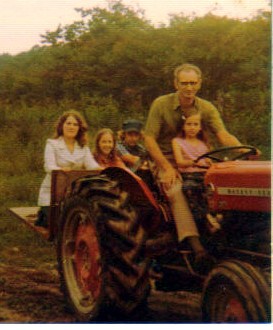
It’s not the back of the truck, but another fond memory on the farm with Dad. On the back: my cousin Debbie, sister Donna, and brother David (JD).

One of my fondest childhood memories is riding in the back of my dad’s truck. I remember being a lookout for a crop of tobacco I had spotted earlier that day, thinking Dad would like to see this field of tobacco. So, when he got in from work, I used my super girl skills to convince him to let me show him. The only problem was I couldn’t find it.

At the time, I was disappointed that something I thought I could connect with my dad was gone. But, looking back, I now have fond memories of riding in his truck, looking for the lustrous tobacco crop I could no longer locate. I now see that Dad took time away from resting after a long day’s work to appease my childhood whimsy.

He saw it as a time to spend with his kids.

My dad got up before dawn every day for 30+ years to drive an hour each way to work at IBM in Lexington. When he got home, he went to the farm to feed, water, and count the cows, besides whatever other chores I did not know about, such as mowing or grading the road with his tractor. And if we happened to be living at the farm (we had spent our summers there since I was nine), he still had to haul water down from our other house every evening because we didn’t have running water at the time. (We thought this was a big adventure – not seeing all the work Dad did to make it happen). I spent many days brushing my teeth with a cup of water and spitting off the side of the porch.

He wasn’t the only one who got up that early; for years, Mom got up with him to prepare a full breakfast before he left for work – at least until they changed their diet to heart-healthy oatmeal. I remember waking up many mornings to the sound of their not-so-quiet whispers in the kitchen. Perhaps the smell of homemade biscuits and gravy, sausage, and eggs awoke my senses to their breakfast chatter; either way, I see how they made time to spend a few minutes alone before we got up.

He did not have to get up that early. He could have grabbed something on the go and spent a few extra minutes in slumber, but he chose to connect with Mom during those early mornings, and she chose to get up with him and make breakfast and sip coffee from saucers in the wee hours of the morning. They found time to spend together in a five-room house full of kids. (Talk about tiny house living – we had no idea it would become popular).

It is those precious memories that aren’t soon forgotten.  I think that is the most important thing God asks of us – to spend time with our heavenly Father. All He wants is to spend time with His kids – and we are better off for taking the intentional time to connect. Sometimes, that may mean getting up a little earlier and being still before the hustle and bustle of our day begins. It is allowing His whispers to seep into our heart and mind awakening us to the sweet aroma of the bread of life that feeds our hungry souls.

Jesus replied, ‘I am the bread of life. Whoever comes to me will never be hungry again. Whoever believes in me will never be thirsty’ ” (John 6:35, NLT, emphasis added).

“Be still and know that I am God” (Ps. 46:10, Emphasis added).