
U-turns Allowed

I recently saw a flock of geese in full-on V formation flying overhead. There were about twenty of them. But, instead of continuing their current path, they managed to do a complete 180 and head in the direction they had just come from; they made a U-turn. I started thinking about the leader. Did he make a mistake in which direction he was taking them? As the rest of the clan followed the leader, how would they know they were on the right path?

This reminded me of my dad. When we went on car rides as a family, we quickly realized that he panicked easily if he thought he missed his turn. The first time we saw this in action, we were headed to the farm after supper, and Mom made a plate for our neighbor, Mr. Hall, something she often did. She told Dad to stop on our way so she could drop off the plate of food.  His house was just around the curve from ours, but Dad had already forgotten. So, just as we began to pass up the driveway, Mom yelled that he missed his turn. Dad slammed on the brakes, and we were rear-ended. This is the first time I recall hearing the term whiplash after my sister Donna’s neck began to hurt.

My siblings and I were sitting in the backseat of our turquoise 1966 Chevy Impala, and with Mom in the front seat, we didn’t get the benefits of her instinctive arm that naturally came across the waists of anyone sitting in the front seat when she was driving. Mr. Hall’s supper ended up all over the inside of the car and us.

After that, Mom learned not to yell when Dad missed turns. The next time we were riding along, and he passed up our turn-off, I remember her calmly turning to him in a monotone voice, saying something like – I think we were supposed to turn there. Panic still ensued, but at least he didn’t slam on the brakes; instead, he began nervously looking for a place to make a U-turn.

As I meandered around the neighborhood, continuing my run that morning, I saw a neighbor walking their dog. When the dog saw me, it wanted to run with me, but the owner, not so much. She guided the dog back to their path with a slight leash tug.

We all go down the wrong path occasionally and make poor decisions, sometimes running off on a whim without consulting God about which direction to take. We may even panic when we realize we are on the wrong path and have made a mess of our lives and caused damage to ourselves and others.

God’s grace not only gives us the space to make a U-turn but helps us clean up the mess and offers complete restoration to heal any damage that occurred while on our hiatus from the path God intended. Thankfully, God is patient with us. We, too, need to be tethered to Christ and let the Holy Spirit guide our hearts instead of allowing our hearts to lead us. The ultimate healing is only found in a relationship with Christ. It is not too late to make a U-turn.

The heart is deceitful above all things and desperately sick; who can understand it?” (Jeremiah 17:9, ESV, emphasis added)
Intentional Connections

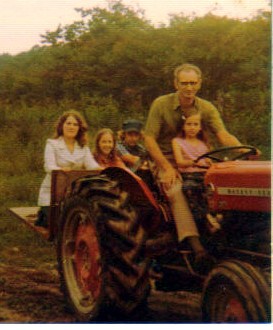
It’s not the back of the truck, but another fond memory on the farm with Dad. On the back: my cousin Debbie, sister Donna, and brother David (JD).

One of my fondest childhood memories is riding in the back of my dad’s truck. I remember being a lookout for a crop of tobacco I had spotted earlier that day, thinking Dad would like to see this field of tobacco. So, when he got in from work, I used my super girl skills to convince him to let me show him. The only problem was I couldn’t find it.

At the time, I was disappointed that something I thought I could connect with my dad was gone. But, looking back, I now have fond memories of riding in his truck, looking for the lustrous tobacco crop I could no longer locate. I now see that Dad took time away from resting after a long day’s work to appease my childhood whimsy.

He saw it as a time to spend with his kids.

My dad got up before dawn every day for 30+ years to drive an hour each way to work at IBM in Lexington. When he got home, he went to the farm to feed, water, and count the cows, besides whatever other chores I did not know about, such as mowing or grading the road with his tractor. And if we happened to be living at the farm (we had spent our summers there since I was nine), he still had to haul water down from our other house every evening because we didn’t have running water at the time. (We thought this was a big adventure – not seeing all the work Dad did to make it happen). I spent many days brushing my teeth with a cup of water and spitting off the side of the porch.

He wasn’t the only one who got up that early; for years, Mom got up with him to prepare a full breakfast before he left for work – at least until they changed their diet to heart-healthy oatmeal. I remember waking up many mornings to the sound of their not-so-quiet whispers in the kitchen. Perhaps the smell of homemade biscuits and gravy, sausage, and eggs awoke my senses to their breakfast chatter; either way, I see how they made time to spend a few minutes alone before we got up.

He did not have to get up that early. He could have grabbed something on the go and spent a few extra minutes in slumber, but he chose to connect with Mom during those early mornings, and she chose to get up with him and make breakfast and sip coffee from saucers in the wee hours of the morning. They found time to spend together in a five-room house full of kids. (Talk about tiny house living – we had no idea it would become popular).

It is those precious memories that aren’t soon forgotten.  I think that is the most important thing God asks of us – to spend time with our heavenly Father. All He wants is to spend time with His kids – and we are better off for taking the intentional time to connect. Sometimes, that may mean getting up a little earlier and being still before the hustle and bustle of our day begins. It is allowing His whispers to seep into our heart and mind awakening us to the sweet aroma of the bread of life that feeds our hungry souls.

Jesus replied, ‘I am the bread of life. Whoever comes to me will never be hungry again. Whoever believes in me will never be thirsty’ ” (John 6:35, NLT, emphasis added).

“Be still and know that I am God” (Ps. 46:10, Emphasis added).

Dose of Encouragement

Everyone can use a dose of encouragement regardless of age or how far we are on our journey.

One morning as I approached the mailboxes on the main street leading into my neighborhood, a gentleman stopped to make a deposit.

As I ran past, he kindly said, “Great job! Keep up the good work.” 

I thanked him and gave a thumbs up. But, as most things do, this reminded me that whether it is running, another sport, or our faith walk with Christ, at the beginning of our training, or a seasoned vet, we can all use inspiration to keep on going, press on, don’t give up.

As I ventured further, I met two other women running in the opposite direction. As my route winds back around, our paths crossed again, only this time they were walking.

As if to justify themselves, one girl said, “It’s hot! We’re from Ohio.”

Oh well, that explains it all…buckeyes. Only kidding. I paid the encouragement forward. But this reminded me of my trip to Austria a while ago. Climate change can make you uncomfortable and disconnected when in unfamiliar territory. I was out of my comfort zone on that trip, so many miles away from home, unable to have my usual quiet time and space. I was trying to find my rhythm on a new route, with new people to meet and work alongside.

Before I left, God gave me a few images: a sundial and Russian nesting dolls. Strange right? It didn’t make sense until I struggled to find peace and saw these images in Vienna. In those moments, I knew God was still with me and that He knew I would need these reminders.

Another time, on a church summer camp excursion with middle school girls, I desperately needed some time away from the chaos to reconnect with God. So, every chance I got, I stole a few minutes away on the other side of the lake to reset, recharge, and refresh my spirit to tackle another night. We all need these times to give us the strength to pour into the lives of others and not get burnt out.

“In returning and rest you shall be saved; in quietness and trust shall be your strength” (Is. 30:15, ESV, emphasis added).

“Encourage one another and build one another up” (I Thes. 5:11, emphasis added).

Distinctly Different

The platypus swam into my dreams a few years ago, leading me to research the creature. The design itself intrigues me. I decided to dig deeper into this bottom feeder and get insight into this remarkable mammal. Interestingly, according to LiveScience, their characteristics resemble that of many different species. Their bill and feet are like a duck, their tail is like a beaver, their feet, body, and fur resemble an otter, and their lizard legs sprawl out to the side of the body when they walk.

In addition, to this extravagant list, they are amphibious. When they are not using their webbed feet in the water to swim, they can retract the web exposing individual nails that allows them to run on land. They also lay eggs, one of only two mammals that do.

Although they do not have teeth and use their cheek pouches to hold food until they can mash it up and swallow it, they have sharp stingers on the heels of their rear feet to defend themselves, with a toxic venom that is quite effective when needed. They are non-life threatening but powerful enough to damage their victim significantly.

This hodgepodge creature has many features of other animals, but oddly enough, the familiar qualities make it unique and distinctly different from the rest. It can undoubtedly relate to the duck by how it uses its bill and webbed feet and the beaver by using its tail to maneuver through the water gracefully, and the otter and lizard by how it uses its feet to swim and run, awkward as it may be.

As children of God, we are given many distinctive qualities, although we can relate to one another because we are made in the image of our Creator. Each of us has gifts given especially to us. We have many of the same characteristics, and all of us, like sheep, have strayed away (Isaiah 53.6). God made us exactly how we are on purpose and saved us by His grace. We can accept everything just as it is – flaws and all. We see the blemishes through our eyes and want to make changes or compare ourselves with others. But if we could see ourselves as God sees us – through His love –we would be content with ourselves and thank God for each unique quality that makes us stand out from the rest.

Post a reminder on your mirror: God profoundly loves you as you are. No matter how we see ourselves, we can be confident in what God is doing in and through us. Obedience is key. We are protected by the armor of faith and love when we wear salvation’s confidence as our helmet (I Thes. 5:8, ESV).

Fuel

My auto-immune and high cholesterol issues have forced me to eat the types of food my body needs for ultimate health to lower my bad cholesterol, raise the good, and get rid of inflammation. I use the word force, but I could ignore it and keep eating foods that worsen my condition. The way I see it, food is fuel for my body. When I don’t eat healthy, I feel it. It’s like putting diesel fuel in a gasoline engine – it shuts off and sometimes causes significant damage.

Fasting is for God – eating is for us.

When God spoke to His people through the prophet Zechariah, He asked them if their fasting during the seventy years of exile was for Him. The Israelites had lost their sincere desire to have a loving relationship with God. Zechariah told them they needed an attitude adjustment – their fasting was not for repentance or worship. They weren’t thinking of God or the sins that caused their exile in the first place (Zech. 7:4, New Living Translation, Chronological Life Application Study Bible).

This passage challenges us today to ask ourselves if we have lost our zeal for God. Are we going to church, praying, and having fellowship with others out of habit or just the experience we get out of it? Does our attitude of worship reflect a genuine desire to know and love God? If it doesn’t, it will lead to ruin (Zech. 7:5-7).

Sometimes we eat junk food out of habit and don’t think about what we put in our bodies or how it will affect our overall health. It’s the same thing for what we put in our minds and allow our eyes to see. In today’s culture, we need to fast from social media and too much TV and instead spend time in God’s Word to feed our minds something healthier that will sustain us and not cause damage –not merely to memorize verses or check a box but with a genuine desire to know and love God more.

Today more than ever, kids have everything at their fingertips on their phones. Social media, internet sites, and video games have explicit content and violence. We need to protect their minds, especially at tender ages, but some of what’s out there is not fit for anyone at any age. Are we honoring God with what we put in our minds? What we read, watch, and saturate our minds with matters because it affects our hearts. Our mind, body, and spirit all work together; if one is off-kilter, they all get out of whack. God can help us re-align and add the right fuel for optimal results.

Wherever your treasure is, there the desires of your heart will also be” (Matt. 6:21, NLT, emphasis added).

Pedal Power

After several neglectful years of hanging up in my garage, I began riding my bike again. I first noticed how much quicker I reached three miles than when I ran, and it made me appreciate the effort I put into my runs that much more.

But here’s the thing – it took some convincing to get me out the door and on it again. I wanted to ride it, but I kept telling myself it would be weird to ride by myself. I spent a good part of the day with the lyrics I want to ride my bicycle. I want to ride my bike  by Queen stuck in my head, but I did nothing about it. I don’t think I have ridden alone very much, even as a child, except for the trips to and from my cousin’s house around the curve so that we could ride together.

The last time I had ridden was with my son when he lived with me, so for some reason, it just seemed strange for me to go for a ride solo. But once I finally convinced myself to do it anyway – it was so much fun! I wouldn’t have known this if I stayed in the house and let those thoughts keep me from trying.

We can miss many blessings by staying in our comfort zones and not going when and where God leads us. I am guilty of that as well, putting off that thing God is nudging me to do because it might feel strange or weird. But we’ll never appreciate the effort that goes into it or experience the joy it brings if we never do it. I am learning to listen to that still, small voice and get out of my comfort zone even when I don’t feel capable.

We are not to measure our abilities by our own strength but by the One sending us.

What is that thing you’ve been putting off that God is nudging you to do? Is it talking to that person down the street or helping that neighbor in their yard? Maybe it’s volunteering at church or visiting the local nursing home – you fill in the blanks – but know, whatever it is, getting out of our comfort zone in these areas is a good experience and will bless us way more than the other person. I bet you will even have fun!

“My grace is all you need. My power works best in weakness” (2 Cor. 12, NLT emphasis added).

“The Lord is my strength and shield. I trust him with all my heart. He helps me, and my heart is filled with joy” (Ps. 28:7, NLT emphasis added).

Unplugged

I woke yesterday morning at 3 AM to a loud pop followed by no electricity. As I lay in the dark, I thought of everything I couldn’t do when I got up – like making my usual oatmeal in the microwave and mixing my protein drink in the magic bullet. I began to wonder what I was going to eat for breakfast.

We sometimes take for granted things like electricity that make our lives easier every day until it’s not there. My strawberry jam sandwich didn’t quite satisfy like my normal oatmeal. Dressing in the dark can become guesswork in whether you put your shirt on backward until you get in the light.

When we unplug from God’s Word, we don’t realize how far we stray from His presence and light until we awaken in the dark. We can substitute the life-giving manna – the bread of life (John 6:48, ESV) – for our own concoctions that don’t satisfy or sustain us. We don’t always realize our dependency on God until we don’t feel His presence and feel like we are in the dark.

Like dressing in the dark, we can’t see how backward our ways are to God’s until we return to His light and let Him lead us and our hearts. In Isaiah 55:8, the Lord declares, “For my thoughts are not your thoughts, neither are your ways my ways.” For this reason, we need to abide in Him (John 15:4, ESV) and lean not on our own understanding (Prov. 3:5, ESV). This is a good reason to be still, listen to His voice, and ask for discernment and direction from the Holy Spirit.

At the break of dawn, as I ran through my neighborhood, I realized the power issue was isolated to just a few houses, and others around me had power. When we go out on our own without consulting God, we can feel isolated and alone, but the truth is that God is always with us. We must plug back into His wonder-working power and acknowledge that we need Him every moment.

I had the opportunity to thank the repair crew working to fix the issues – how many times do we remember to thank God for what we have instead of focusing on what we don’t have, which can lead to self-pity or complaining? We will probably not receive more until we are grateful for what we have now—just food for thought.

Jesus’ Letters

“I will come to you and remove your lampstand from its place unless you repent” (Rev. 2:5, ESV, emphasis added).

That can’t be a good thing.

I don’t know about you, but I don’t want Christ to remove the light within me because I did not hear and heed His warnings to repent.

The book of Revelation holds many mysteries and sometimes seems scary to read, but the book begins with the apostle John, who has been exiled to the Island of Patmos, recording letters from Christ to the seven churches.

Each letter has an “I know” statement from Christ, diagnosing the church’s condition, continues with a warning to hear and heed what the Spirit is saying, and then supplies a solution that graciously comes with a promise and blessings for those who persevere.

Christ invites everyone to examine themselves, considering these messages. We should make sure the light we think we have isn’t darkness (Luke 11:35). An excellent way to do that is to ask God to reveal anything in our hearts that is not of Him so we can declutter and make more room for the Spirit.

The repetitive message to each church is to listen to what the Spirit says – in other words, heed the warnings. Ephesus is warned to return to their first love; Smyrna and Philadelphia are only given praises and encouragement to be faithful to death while promised that faith in Jesus assures access to the eternal kingdom, even in the face of persecution; Pergamum and Thyatira are warned about false teachings and immoral deeds; Sardis is told to wake up and complete her works of obedience; and finally, Laodicea is told to turn from self-deception and repent of their lukewarmness.

Each end with a different promise, a blessing for those who conquer. I won’t list them all here, but I encourage you to reread these passages as if they are written to you personally. These letters may have been recorded to address issues in the churches of their time, but they are a single unified message to the church in all times and places. The state of the churches in John’s time is similar to today (Brand, 2015).  

God still calls Christians to faithfulness and integrity. Those who heed the message will reap God’s promised rewards, and those who fail will be judged. I pray that our lampstand is not removed – I thank God for His mercy and patience. I am grateful for the Holy Spirit’s correction and guidance. In God alone, we can persevere and reap the promised rewards.

Cite:

Brand, C., ed., Holman Illustrated Bible Dictionary, (Nashville: B & H Publishing, 2015).

Puddles

Does a puddle still elicit childhood memories of splashing in your rain boots? Small, seemingly insignificant items can trigger these and many other memories throughout our day. But how do we store all those memories and still take on all the new information we receive daily?

Our brains are like sophisticated filing systems, constantly storing, retrieving, and discarding information. We receive a tidal wave of new information daily – and a lot of insufficient data is included.  So, how do we process it? Where do we store it or get rid of it?

We must counteract it with good by intentionally replacing it with God’s Word.

In the Old Testament, we read that God provided manna from heaven each night with the dew to feed the Israelites in the wilderness. Manna is described as a white or pale-yellow gum resin that resembled a tiny coriander seed and tasted like honey wafers (Numbers 11:7; Ex. 16:31, NLT). It is labeled as bread from heaven (Ps. 105:40, ESV) and was ground and baked into cakes (Ex. 16:13-36).

Manna foreshadowed Christ, the authentic Bread from Heaven (Brand, 2015). Jesus assured the Jews that He, not the wilderness food, was the true Bread of Life from heaven that brings eternal life to those who eat it (John 6:30-58). Jesus Christ nourishes people spiritually and is the only satisfaction for our souls. The Word was with God (interpersonal relationship between Christ and God). The Word was God (Jesus is the same God who created the universe) (John 1:1). The Word became flesh and dwelt among us (John 1:14). Jesus speaks words of eternal life. The Holy Spirit works powerfully in and through the words that Jesus says (John 6:53). The Triune – God the Father, God the Son, and God the Holy Spirit, three in one.

Like fabricated memories, our lies can become real if not discarded. They need to be replaced with God’s truth daily to give us spiritual food. It can become toxic and overwhelming if we don’t substitute lies for truth regularly. That is why it is so important to intentionally carve out time to spend in God’s Word, to seek Him above all else, and allow the Holy Spirit to awaken your spiritual life.

After proclaiming Himself as the Bread of Life, Jesus promises never to reject those who come to Him and trust Him for salvation (John 6:35-37). This is manna – food for our souls – a hope to cling to that replaces the magnitude of insufficient data we consume daily.

Cite:

Brand, Chad., ed. Holman Illustrated Bible Dictionary, B & H Publishing, 2015.

He Isn’t Here!

Would you prefer to receive flowers when you can enjoy them or spread them out across your casket after you’re gone? I would wager that most of us want to give and receive them now while we can see the person’s reaction and smile. At least, that is my preference. I have often said, if you cannot give me flowers while I am here – don’t bother after I am gone.

When Mary, sister to Martha and Lazarus, poured expensive oil over Jesus’ feet from an alabaster jar, she received havoc from the disciples for wasting it (Mark 14:3, ESV). Jesus scolds them for getting on to her and tells them she has anointed Him in preparation for burial. I’ve read this passage many times, but what stood out most recently is the word Jesus uses when he responds – BEFORE my burial (v 8).

I see the alabaster jar and its expensive nard, symbolic of Jesus’ body and blood that was broken and spilled for us; what a precious gift that was and still is something to be cherished. We should be as generous as Mary and give our very best to Christ and others as Christ commands us while they are still alive to receive it.

We also see Jesus washing the disciples’ feet before He goes to the cross (John 13:14, ESV). This act served as a humble example for them to follow. Being humble does not mean you think less of yourself, but you think of yourself less. In Luke 6:31, Jesus tells the disciples that if they want someone to do something for them, they take the initiative and do it first for others. Otherwise known as the Golden Rule.

A few years ago, I had the opportunity in a leadership class to do an exercise where I asked my family and friends to give me a one-word description of myself. Then you ask why they chose that word. I highly recommend this – not so you can solicit (hopefully) kind remarks, but to hear them before you are gone. Please do it for someone else as well. So many times, we don’t take the time to tell someone how we feel before it is too late.

Your challenge this week during Holy Week is to look for ways to show Christ’s love for you to someone before they are gone. What small acts of kindness in love can you do for someone?

I will leave you with this Good News: “He isn’t here! He is RISEN…” (Matt. 28:5, ESV emphasis mine). Celebrate that this week by showing kindness and love to others as a gift to Jesus because whatever we do for others, we are doing for Christ (Matt. 25:40, ESV).