
PREPARATION

After John the Baptist baptized Jesus, He was taken to the wilderness, where He fasted and spent the next forty days and forty nights tempted by Satan (Matt. 4:2, ESV). The devil focused on three areas: desires and physical needs, possessions and power, and pride (Matt. 4:1-10, NLT). Things that often trip us up. Each time Jesus used the Word of God to defend Himself by quoting Deuteronomy, which links His experience to Israel’s forty years in the desert. Israel failed, but Jesus did not.

TemptationVerseJesus’ AnswerVerse
Hunger: turn stone into breadMatt. 4:4; Luke 4:4Depend on GodDuet. 8:2-3
Power: jump; the angels will protect youMatt. 4:7; Luke 4:12Do not test GodDuet. 6:16
Pride: offered a shortcut to His future reignMatt. 4:10; Luke 4:8Do not compromiseDuet. 6:13

When we are hungry and tired, we are more susceptible to giving in to the wrong things. In those times, we can learn to depend on God even more. The devil used manipulation and lies by twisting Scripture and taking Psalm ninety-one out of context to convince Jesus to jump and use His divine nature to display His power, knowing that the angels would protect Him. But Jesus says we are not to tempt God. Lastly, the devil offers Jesus a shortcut to reign over the world, but this would only bypass the most critical piece of Jesus’ mission; redemption of sins for His people, which is precisely what Satan hoped he could deter. Jesus is the perfect example of not comprising to please the flesh.

All the time spent in the wilderness was preparing Jesus for His ministry. He became fully human and took time to understand as a human what we go through each day on this earth. He learned obedience through what He suffered, and so can we. Our testing and temptations come first to prepare us for living a life of faith and obedience to God. It is by His strength, not our own, and because Jesus knows what we are going through, we can look to Him for strength during times of temptation and trials.

We can also use the sword of the Spirit as our weapon (Eph. 6:17-18) to rightly divide the Word of truth (2 Tim. 2:15). To use it effectively requires faith in God’s promises. We must stay alert to the devil’s tactics; he also knows Scripture and will twist it to suit his purposes. The Chronological Life Application Study Bible notes that obeying is more important than memorizing or quoting a verse. Reading the Word daily and applying it to our lives is the only way to keep our sword sharp and not give in to the devil’s lies.

There is another type of wilderness we sometimes spend time journeying through. In the life of John the Baptist, we read that he knew his purpose. He was to pave the way for Jesus the Messiah. The Bible doesn’t tell us much about his childhood or how he spent his time before his ministry began, but it does tell us he waited in the wilderness until God’s appointed time to start his ministry (Mark 1:3-4, ESV). Can you imagine knowing your purpose and waiting for God to tell you the time is right? At a time when I was at rock bottom, God whispered a sweet message for me to think positively because great things were happening in my life. It was hard to see then, but He has certainly done great things, and I know He will continue to do so. He reminded me of that again recently during a ‘wilderness’ moment.

Just a few short years ago, I would have never seen myself where I am now. He is always working in our lives even when we cannot see it. I am learning to wait expectantly for God’s perfect timing. Time spent in the wilderness of our lives also has a purpose and is a time of preparation, and we cannot skip ahead. After we stand the tests and rely on God’s strength and Word to get through, we are more prepared and ready to be sent out to do kingdom work for God.

AUTUMN SPICE

Reflections

Most who know me know I am an avid runner. One of the first things many people ask me is how far I ran that morning, usually between a mile and a half and three miles on a good day. Although I keep track of it in my running journal, it is not so much about the quantity as it is the quality of the time spent with God. Lately, my runs have been shortened due to construction in my neighborhood. But since they don’t work on Saturday, I enjoyed my regular three-mile route in between homework assignments for what turned out to be a nice leisurely run on a crisp Fall morning.

Whether a mile or three, my communion time with God is a valuable part of my day; when I receive a message on top of it, it is like pouring a ladle of rich, savory gravy on an already succulent dish of mashed potatoes. Thinking of food, I could also relate it to a double dose of whipped cream piled on top of a sweet and creamy Autumn Spice milkshake from Chick-fil-A, which I have already had two of this Fall; one by surprise and one my choice. I think they knew what they were doing when they handed me that unsolicited milkshake a couple of weeks ago. When I said I hadn’t ordered it, they said you might as well take it. And who can resist that type of arm twisting when sitting in the drive-thru? And yes, I did go back last week and enjoy another one on purpose. No arm-twisting this time.

Sometimes, God surprises me with messages; like this one that can feel like getting a free milkshake with whipped cream on top. But even when I am working on a particular topic or processing what He gave me in my quiet time or Bible reading, I am always in awe of His gracious mercy and abundant provisions. He knows I depend on Him, and that is how He wants it. Although it is not always easy, I wouldn’t have it any other way.

“For thus said the Lord God, the Holy One of Israel, ‘In returning and rest you shall be saved; in quietness and trust shall be your strength’” (Isaiah 30:15, ESV). Emphasis mine

Let’s read that again as translated by The Message: “God, the Master, The Holy of Israel, has this solemn counsel: ‘Your salvation requires you to turn back to me and stop your silly efforts to save yourselves. Your strength will come from settling down in complete dependence on me’” (Is. 30:15, MSG). Emphasis mine

Isaiah was referring to Judah and their rebellion against God. They were stubborn and wanted to go by their plans. They put their trust in Egypt rather than God. Isaiah is getting to the heart of the matter by showing them where their strength comes from. In this context, ‘ returning’ means to repent, which leads to our salvation. The only true path to victory and peace is through quietness and trust. Even in this OT story about Judah’s rebellion, there is still a universal truth and principle for us to pay attention to. As we travel through this passage and on to the following verses, we see a picture of God’s almighty grace towards his people.

Despite our rebellion and serving other idols in our lives, we are still being shown an abundance of grace and mercy. This is a call to turn back to God, rest in His grace and the promise of salvation, in the quiet confidence of God’s strength. That is a solid dose of whipped cream on an already sweet and savory message and something worthy of reflection.

STEADFAST ANCHOR

A seahorse uses its tail to anchor itself to coral and seagrass. They have no stomachs, so food passes through their little bodies, requiring them to eat almost constantly. It sometimes stays in the same place for days, using its secure position to snatch much-needed food to sustain itself. They have the same kind of tails that monkeys do, called prehensile, which means “used for grasping.”[1]

With that in mind, we know how anchors are used for keeping ships in place. When Paul sailed to Rome, fearing they might run on the rocks, they let down four anchors when they got to Malta and prayed for the day to come (Acts 27:29, ESV). Anchors were usually made of heavy stone, iron, or lead during biblical times.[2] It makes sense that anchors are secure, potentially unmoveable objects.

The author of Hebrews uses an anchor to describe the certainty of God’s promise of salvation through Jesus. They use the image of an anchor, already affirming its secure nature, and use the word steadfast to describe the anchor. The ESV Study Bible denotes that God’s promises were guaranteed because of His trustworthy character (Heb. 6:16-18, ESV).

Steadfast comes from the word bebaios, which means “that which does not fail or waver, immoveable, and on which one may rely; to establish.[3] Its synonyms are safe, trustworthy, sure, faithful, and true. When I searched for the word steadfast in my Bible app, I found Ephesians 3:17-19, which does not include the word but affirms our secure salvation in Christ. “So that Christ may dwell in your hearts through faith- that you, being rooted and grounded in love, may have the strength to comprehend with all the saints what is the breadth and length and height and depth, and to know the love of Christ that surpasses knowledge, that you may be filled with all the fullness of God.”

Did you catch the words, rooted and grounded? Doesn’t that sound like the characteristics of an anchor? So, is the author of Hebrews not only confirming with the firmness of an anchor but also the safe and secure, actual trustworthiness of a steadfast anchor– where our hope lies, in Christ? Hebrews gives double measure in confirming God’s promises to us.

God gives us sweet promises that we can hold on to, as a seahorse holds on to coral, to be fed all day long with life-sustaining nutrients; we, too, can receive spiritual food in God’s Word to sustain us while we anchor ourselves to Christ. A great way to do that is to take the Psalmist’s advice, “Be still, and know that I am God” (Ps. 46:10, ESV). This relates to Moses telling the people, “The Lord will fight for you, and you have only to be silent” (Ex. 14:14, ESV). We constantly need life-sustaining manna from heaven, a secure hope that anchors us in place while we wait. God’s promises find their Yes and Amen in Christ (2 Cor. 1:20, ESV), giving us a double measure of trust in the One who does not waiver and never fails.


[1] Beverly Hernandez. “Learning About Seahorses.” ThoughtCo. https://www.thoughtco.com/lesson-3-learning-about-seahorses-1834130 (accessed October 5, 2022).

[2] Chad Brand. ed., Holman Illustrated Bible Dictionary, (Nashville: B & H Publishing, 2015).

[3] Spiros Zodhiates., and Warren Baker. Hebrew-Greek Key Word Study Bible : Key Insights into God’s Word : King James Version, Authorized Version. Second Revised Edition. Chattanooga, TN: AMG Publishers, 2008. Print.

CROSSROADS

I can look back over my life and see times when I was at a crossroads. I could choose life or death. I didn’t realize they were such desperate choices at the time, but they were. I often chose the wrong path, which I now know, led to a type of death- loss of self-worth, my identity, and self-control, and I took on lots of fear and shame because of it. I put a man in the seat only God is to hold in my life and heart. I now know my identity is only found in Christ, as a daughter of the King.

I wasn’t rooted in God’s Word and steeped in His love then. Have you ever thought about the crossroads you encountered over the years? What are three things you would tell yourself if you could? I would say to myself:

  1. The devil is a liar (John 8:44, ESV).
  2. Don’t settle for anything less than God’s best.
  3. You really can have a relationship with God and learn how to put Him first in your life.

Let’s take a moment to unpack those. First, Jesus said, “I am the way, the truth, and the life” (John 14:6). He goes on to tell the Jews who had believed in him, “If you abide in my word, you are truly my disciples, and you will know the truth and the truth will set you free” (John 8:32). They question him about being a slave. He explains in verses 34-36 that everyone who practices sin is a slave to sin, but the Son (Jesus Christ) can set you free. The devil would like us to think the opposite. He can twist the truth to appeal to the flesh and make us feel we are free to do as we please with our bodies, which leads me to number two.  

Not settling for anything less than God’s best means not compromising integrity for momentary pleasure. It is not worth it, and it leads to death. The Cambridge Dictionary defines integrity as the quality of being honest with strong moral principles. God always wants the best for us. God must be our biggest desire, which leads me to number three.

I always believed in God, even as a child. But I didn’t know how to have a relationship with God or understand how my little heart could love Him more than my family. Learning how to put God first in my life was life-changing and made all my other relationships better. Because of my love for the Father and His love for me, I can love others better. When we align our hearts’ desires with God’s desires for us and not only believe but accept Christ as God’s Son and our Savior, everything else falls into place.

These two verses (Ps. 37:4; Matt. 6:33) go hand in hand: If we can learn to seek the kingdom of God first and foremost, our biggest desire is God, and our hearts are filled with His love, which leads to unspeakable joy. Even when this broken world delivers terrible news and death, there is always life-sustaining Good News that leads to eternal life as we wait expectantly for Christ to return. I encourage you to choose life if you find yourself at a crossroads.

“Delight yourself in the Lord, and he will give you the desires of your heart” (Ps. 37:4, ESV, Emphasis mine.)

Seek first the kingdom of God and his righteousness, and all these things will be added to you” (Matt. 6:33, ESV, Emphasis mine.)

Cambridge Dictionary, https://dictionary.cambridge.org/us/dictionary/english/integrity

THE BATTLE IS THE LORD’S

God equips us for battle through spiritual armor (Eph. 6:10-18, ESV). We are victors because of Christ, not our power or strength, but God’s. God uses the weak and foolish things by the world’s standards to show His power and strength (I Cor. 1:27-28, ESV). He gets all the glory.

We see an example of this in the OT. When we are introduced to Gideon in Judges 6-7, he is threshing wheat in a winepress. Typically, the threshing floor was in a high place in the open so the wind would blow away the chaff. But Gideon hid in the winepress from the Midianites, who were oppressors. God sent him a message that he wanted him to fight them.

Gideon pleads with God by telling Him he is the weakest person in the weakest clan. But that is precisely whom God wants to use. He reassures Gideon that He will be with him. When he arrives for battle, God reduces what army he has from 32,000 to a mere 300 men. With God’s wisdom and power, they came away victorious. Gideon was fearful and didn’t want to go- but in his obedience, God used him to carry out a purpose.

2 Chron. 20:15-17 is similar; we read about God telling Jehoshaphat to stand firm, fear not, and that they would see the salvation of the Lord fight for them. The ESV Study Bible notes that it was not Judah’s place to take up arms but rather to exercise their faith and offer prayer and praise to God. Jehoshaphat’s call to faith is based on Is. 7:9, “If you are not firm in the faith, you will not be firm at all.”

Jehoshaphat calls the people to believe in the Lord your God, and they will succeed (2 Chron. 20:20). Without faith, it is impossible to please God (Heb. 11:6). Whoever draws near to God must believe that He exists and that He will reward the ones who seek Him.

Knowing what we deserve and who we are by nature invokes fear, but knowing we are chosen and redeemed by the power of the blood of Christ, and we know whose we are,= no fear. It all leads to faith and obedience in the One who made us and fights for us, the One we can believe will be with us through all our battles.

I have battled a fear of public speaking since I was a child. I would have gladly taken an F instead of doing an oral book report, but that wasn’t a choice. I will say that in my jobs, and now in my personal life, there are many opportunities when God calls me to speak in public. It is still not the easiest, and I am not an eloquent speaker, but I have learned to trust God, whom I say must have a sense of humor, to help me through it. In that way, I can personally relate to God using the weakest for His purpose to bring glory to His name.  

PRISM

The Oxford Dictionary defines a prism as “a glass or other transparent object in prism form, especially one that is triangular with refracting surfaces at an acute angle with each other and that separates white light into a spectrum of colors.

We could be called God’s prism. His light shines into our lives, illuminates us, and refracts back into the lives of others, bringing an array of color to those around us. But without Jesus, there is no light to refract. Jesus is the light of the world (John 8:12; 9:5, ESV). He adds color and light to our lives.

Recently, I heard a speaker share their story and use the analogy that depending on what audience they are speaking to decides the version they tell, either plain glass or stained glass. The latter includes God, while the other does not, highlighting the same moral principles. The plain glass has the same premise as a white peacock; it still spreads out a full array of feathers without a colorful display.

Stained glass is colorful and full of beauty and intricately detailed artwork; it changes how we see the light reflected through it. I hope always to choose stained glass because Jesus is at the heart of it. He is the only reason my story exists. Because of God’s redemptive story, which is the theme of the entire Bible, I would not be here to share my story.

Upon being requested to talk with our group, the speaker admitted that they asked if it was safe to mention God. I am not saying I always get it right; I know I have missed the mark many times by passing by someone I should have shared Jesus with; I pray for courage, strength, and God-confidence to do the things God asks me to do. The speaker gave a remarkable testimony with an inspiring personal and business model. But, as we see how the disciples were treated in the early days after Jesus ascended to heaven, proclaiming Jesus as our Savior isn’t a safe endeavor. Still, we are called to share the Good News of His saving grace (Matt. 28:19-20, ESV).

As I thought about this testimony, I wondered if it could be compared to Paul, who writes that he became all things to all people so he might save some (I Cor. 9:22, ESV). But even when he was in Athens, a city full of idols, he told them about God when he shared with them that the alter of the “unknown god” they were worshipping was God, who sent Christ to die on a cross so they may be saved (Acts 17:23-31, ESV). As an influential person in society, maybe the part they are leaving out of their plain glass story is precisely what the other crowd needs to hear. Hence, their perception of the light will reflect all the colorful details of God’s handiwork in our lives through the lens of Jesus Christ.

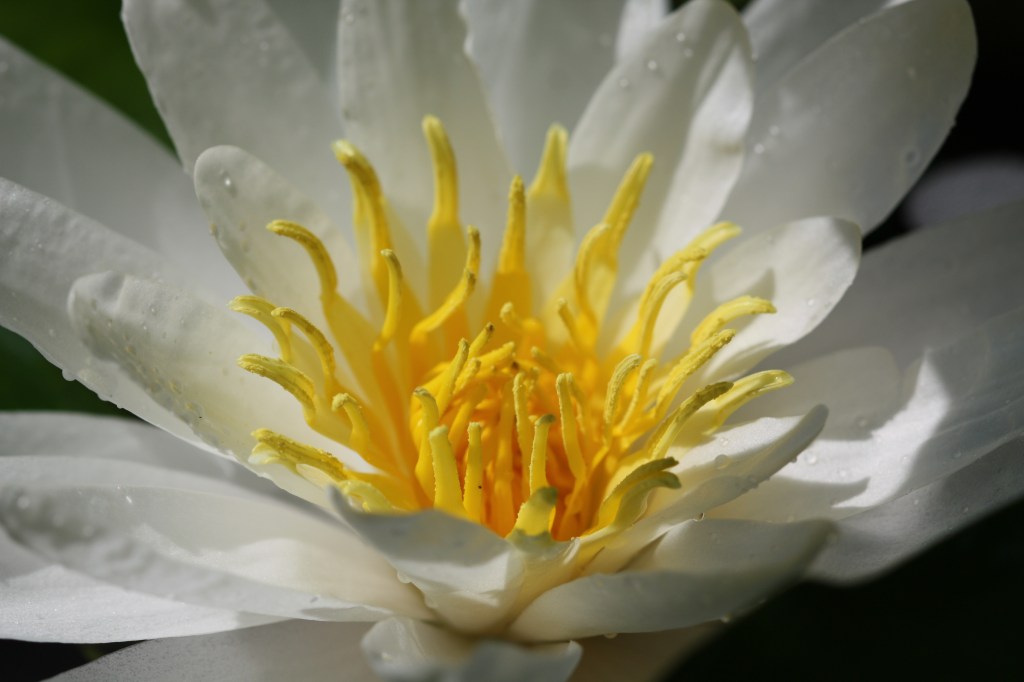
WATER LILY

A beautiful bloom that emerges from the mud.

As a habit, I tend to take the same route on my morning runs. Still, I realize there are other streets I can take to change up my routine; on occasion, I do. Admittedly, it’s usually only when something impedes my path, and I’m forced to alter my route. It could also just be an uncomfortable feeling that redirects me.

This happened recently, and as I chose a new street and zigzagged through my neighborhood, exploring new choices, I Cor. 10:13 popped into my head. Paul writes of God’s faithfulness and that through even the worst temptation; God always provides a way of escape.

There was a time in my life I didn’t know I had a better choice. Satan doesn’t want us to know there is always another way. I was once given an ultimatum from the devil himself (through my abuser). My options looked bleak. I made the wrong choice, leading me down a dark road.

My old habits caught up to me. I was in mire up to my eyeballs and ready to sink before I saw the light and surrendered everything to God. God gave me a literal wake-up call. He is The Better Choice. He taught me how to find my voice and say no to the wrong things that kept me in the pit for so long. Therefore, I can relate to the water lily as it arises from the mire to transform into a work of art by the hand of God.

I want others to know there is always a better choice. A non-sinful choice that honors God and us through healthy decision-making. There is a new life waiting. God’s love is enough.

“No temptation has overtaken you that is not common to man. God is faithful, and he will not let you be tempted beyond your ability, but with the temptation, he will also provide a way of escape, that you may be able to endure it” (I Cor. 10:13, ESV, emphasis mine).

THE ORDER OF MELCHIZEDEK

As a kid, I remember hearing my dad preach from Hebrews 6:19-20, “We have this as a sure and steadfast anchor of the soul, a hope that enters into the inner place behind the curtain, where Jesus has gone as a forerunner on our behalf, having become a high priest forever after the order of Melchizedek.” (Emphasis mine)

I often wondered what that meant. I think I had questions I never asked my dad, like if Melchizedek was a real person, and if so, what does it mean that Jesus became a high priest after the order of another human? What curtain? Understanding what ‘the order of’ meant would have significantly helped. But somehow, I never got around to asking him.

I was reminded of this verse recently and realized it was time I took a deeper dive to get a better understanding with God’s help. The first time Melchizedek is mentioned in the Bible is in Genesis 14:18. He was the king of Salem, which is associated with or short for Jerusalem. He was a priest of God most high.

He is mentioned again in Psalm 110:4 and then in Hebrews. But that is it. Scripture doesn’t tell us where he came from or what happened to him. Hebrews’ account of him is that he was an ordinary man, his name means king of righteousness, and he was king of Salem– meaning king of peace. Hebrews 7:3 says that he resembles the Son of God and continues to be a priest forever. In Scripture, there is no recording of the end of his life, so in that sense, he continues forever.

After the order means to be like someone, a model or pattern, also known as a “type.” We see this with Adam, who was a type of Christ. According to the ESV Study Bible, both are covenantal heads of humanity; as such, we are either in Adam or Christ. All of us are born in Adam by physical birth as sinners, while those born again in the new birth are in Christ. With that in mind, Melchizedek was a type and figure that foreshadowed Christ. Christ is truly the King of Righteousness who brings true Peace.

Before Christ, Levitical priests offered sacrifices in the Most Holy Place behind the veil or curtain once a year; no one else could go there, so the priest provided the sacrificial blood of animals to draw near to God on others’ behalf. But when Christ died on the cross, he tore the veil and made a way by His blood for everyone to draw near to God, once and for all. He defeated death when He rose from the grave. The passage in Psalms primarily tells us about the final King, the Messiah, and that it cannot be revoked once it takes effect.

Jesus Christ, by God’s oath, is a permanent and eternal Priest of God Most High and King of all Kings who will live forever, allowing His followers access to God- to draw near Him in a Most Holy Place, based on His person and work. Melchizedek’s name alone can indicate a person’s relationship with God, and he came as a foreshadowing of Christ, pointing others to the real King and Priest, who sacrificed everything for us so that we might live forever.

God’s righteousness and holiness demand an answer for sin. But His love for us is so deep that He supplied the answer through His Son Jesus Christ. Bottom line: God wants to be in an intimate relationship with us. His biggest desire is for us to accept the offering of His Son, Jesus, in our hearts. That is the point of the redemptive story of the Bible. God sent Jesus, who made way for us to draw near God. That’s it! The secret ingredient in the recipe of life. The key to navigating this broken world while we wait expectedly for Christ, the King, to return. We make drawing near to God the biggest desire of our hearts. We will never measure up, but because of Christ, we don’t have to.

IN THE GARDEN

Humming with her father, she carefully planned each step, stretching her little legs as far as possible to reach the imprint he had made in the freshly tilled soil. She placed her tiny foot inside his impressions nearly three times before moving on to the next. Heeding his instructions, she dropped one or two seeds into the holes he prepared. He did not need her help to carry out his goal but delighted in teaching her the way his father had shown him.

The tiny building beside the garden where livestock once found shelter from the storms now only housed the dry dung from long ago. Using the dirty silver bowl she found inside, she joyfully scooped one serving at a time and carried it to the garden as a fertilizer to ensure ultimate growth. The dry, arid land lapped each drop from the jug; she gripped the handle tightly as she moved on to the next. Helping her father in the garden was hot work but would be most rewarding when new life sprang forth.

Many years have come and gone, and her earthly father has passed. But, once again, with childlike wonder, the little girl carefully follows in her Father’s footsteps to help Him in the garden, trying her best to follow every instruction. With each drop from her bucket, thirst is quenched.

She spreads the seeds of His love in the cultivated hearts, fertilized with the dung from her past. She knows she may not see the final stage of new life that springs forth, but she is content to share even a tiny part of their unique journey.

The living water that flows from the Father above into her life and the lives of others is enough to sustain her. She joyfully sings a new song He places on her heart and praises His name for the freedom it brings. Free as a bird to soar overhead, carry His messages, and spread His love.  All of this He could do on His own- but He chose her for His purpose to give meaning to her life and help her grow in the full richness of His glory.

We are part of His grand design to follow His path and help each other using our gifts for His glory. The few who find it and follow in His steps will be blessed beyond measure. The more we lift to Him, the more that will be poured back down, to return even better than how we released it.

In the garden of life, He has set a path for us to follow. He goes before us to guide us each step of the way. In childlike wonder, we look up to the Father as He lifts us on His shoulders for a new perspective we are to share with others. The path leads to His kingdom and glory not yet known. But its beauty will amaze us – don’t you want to come along?

SURE-FOOTED CONFIDENCE

Habakkuk may be a small book, but it packs a powerful message that I believe is relevant to us today. Even though it refers to a time of unrest for Judah, the prophet’s cries to God are relatable. Habakkuk goes to God with his complaints and questions His tolerance of evil in the world. He begins in 1:3 with a lament to God and asks why He isn’t punishing sin. God responds in 1:5-11 by letting him know He has already started to answer his prayers. God is always working; we don’t always see it.

Then, he makes another complaint to God. His second lament is that God lets the wicked go unchecked (Hab. 1:12-2:1, ESV). God again responds and assures Habakkuk He will punish the wicked at the right time (Hab. 2:2-20).

Habakkuk begins to look forward to the day that God’s glory will fill the entire earth (Hab. 2:14). We certainly have hope in that truth. In verse 20, he recognizes the sovereignty of God who rules the whole world and that His extraordinary nature calls for silence. 

Finally, he remembers things God has done in the past, prays for God’s wrath and mercy, and begins to reestablish his trust in the Lord because of who He is (Hab. 3:1-19). He begins to rejoice in the God he knows he can trust, in the God who knows best. Even among the suffering, he finds joy in that trust because joy is not found in the circumstances but God alone. He finds strength in Yahweh for sure-footed confidence in God. He proclaims he can live on great heights even amid extreme cases (3:19).

He began with complaints and telling God how to run the world and ended by trusting God, who knows best and will bring justice to a sinful world. The same is still true today. Sometimes our faith waivers, but we can find hope in God’s sovereignty and that He will triumph in the end. We can also take our questions to God when we are troubled about the sin in the world. We may not always see what God is doing – but we know who He is and can trust Him as we lean on Him for strength and experience joy in all circumstances while we wait expectantly.