Journaling for Spiritual Growth

Handwritten notes are becoming a lost art. There are many advantages to handwritten notes, besides being thoughtful and showing you care, according to a blog article by Stackoverflow, it is still the best tool for retaining information, improving reading comprehension, and memory.

Along those lines, journaling also has many beneficial traits that enhance spiritual growth. As new year resolutions are prominent, it is best to consider lifestyle changes for a healthier mind, body, and spirit, rather than short-term goals that never quite last.

When I became a Christ-follower, like handwritten notes, I found journaling, while reading my Bible, helped me retain information as I wrote things that stood out to me, along with daily prayers and scriptures. Something I still do daily. It is also nice to go back and read entries from my spiritual journey.

In the tapestry of our hectic lives, a hidden treasure awaits discovery — the transformative practice of Christian journaling. This article invites you to embark on a unique journey, exploring ten distinctive tips that not only enrich your faith but also unveil the extraordinary power of journaling in your spiritual growth.

1: Craft Sacred Moments in Time:

Carve out dedicated moments, crafting a sacred rendezvous with your journal.

Why: These appointed times serve as sanctuaries where divine connections and revelations unfold, reinforcing a steady rhythm of spiritual communion with the Holy Spirit.

Nurture Sanctuaries of Silence:

2: Seek out tranquil spaces that cradle your thoughts in silence.

Why: These sanctuaries foster an environment where whispers from the Holy Spirit are heard, allowing your reflections to flourish in the serene embrace of sacred quietude.

Harvest Gratitude Seeds:

3: Plant the seeds of gratitude at the start of each entry.

Why: By cultivating gratitude, you create fertile soil for spiritual blossoming, where every entry becomes a testament to the abundant grace surrounding your life. Gratitude adjusts your attitude.

Scripture-Woven Meditations:

4: Intertwine your reflections with the rich threads of Scripture.

Why: As you weave God’s Word into your narrative, the tapestry of your faith deepens, creating a luminous panorama of divine guidance and insight.

Courageous Emotional Dialogues:

5: Courageously pen down the symphony of your emotions, both highs and lows.

Why: Honest expression begets emotional release, and by sharing the depth of your heart, you embark on a journey toward healing and authentic spiritual connection.

Goals as Spiritual Compasses:

6: Chart your spiritual course by setting both short-term and long-term goals.

Why: Goals become compasses guiding you through uncharted territories, infusing your journey with purpose and direction. Ask God to help you set and keep them.

Inscribed Prayers:

7: Transform your journal into an intimate dialogue with the Holy Spirit.

Why: By allowing your prayers to dance on the pages, you embrace a sacred conversation, nurturing a profound connection with God that transcends the limits of spoken words.

Milestones as Testimonies:

8: Pause to celebrate and immortalize the milestones on your faith journey.

Why: In acknowledging these pivotal moments, you not only celebrate growth but also create a living testimony to God’s faithfulness in your unique narrative.

Challenges as Spiritual Forges:

9: Chronicle your challenges, seeking divine guidance and resilience.

Why: Within the crucible of challenges, your journal becomes a forge where faith is refined, and through prayerful reflection, you emerge stronger, anchored in the unwavering hope of God.

Conclude with a Surrendered Amen:

10: Conclude each entry with a prayer of surrender, placing your day in God’s hands.

Why: This concluding act of surrender is a sacred seal, affirming your trust in the Divine authorship of your life’s story and inviting the peace that surpasses understanding.

Benefits of Journaling:

In the artistry of journaling, you unearth a reservoir of benefits. Beyond the written words, the act of journaling becomes a sacred voyage that deepens self-awareness, fosters emotional well-being, and cultivates an intimate relationship with the God. Your journal becomes a mirror reflecting the tapestry of your faith journey, a map guiding you through unexplored realms, and a timeless testament to the extraordinary power of a pen dipped in grace.

I encourage you to pray for the best way to set an affective daily spiritual growth plan that you will stick to, for years to come, with God’s help and direction.

Happy New Year & happy journaling!

The Potter

The Potter

In the ancient world, a clay jar was likened to human weakness. Apostle Paul refers to the “knowledge of the glory of God in the face of Jesus Christ” (2 Cor. 4:6, English Standard Version) as a treasure in jars of clay (v.7). Standing for the principle of Christ’s crucifixion – God triumphs during human weakness.

Similarly, Isaiah refers to God as our Father – the Potter. At the same time, we are again seen as the work of His hand – the clay (Is. 64:8). Other references are made throughout the Bible as a vessel of clay, a broken vessel, and God as the shaping agent or Potter. Nevertheless, I was drawn to the story of Jeremiah when the word of the Lord came to him and told him to go to the potter’s house.

To set the stage, the book of Jeremiah is set at a time of political turmoil, following the fall of the Assyrians and the rise of the Babylonians. He saw the destruction of Jerusalem and the temple, with many Judeans deported to Babylon.

First, Jeremiah saw the potter working and shaping the clay on his wheel. The potter spoiled the clay and reworked it with his hands into another vessel that seemed promising. God then spoke to Jeremiah about the house of Israel. Likewise, God can reshape Israel (Jere. 18:4-5).

We are also a work of the Father’s hand. Since Christ came to redeem us from our sins, we can be reshaped into usable vessels to bring glory to God. God created and helped us in our weakness, like the clay jar. The Holy Spirit’s work within a believer has the power to transform our hearts for honorable use to further the Kingdom of God.

We cannot do this work on our own. Our most sincere desires to change old behaviors are limited if we don’t have the power of God’s Spirit within us. This requires surrendering to the Potter and allowing Him to do the work from the inside out. No matter how many times we change locations or jobs – without a heart transplant – our efforts to change are fruitless.

Isaiah supplies the secret to Judah’s strength. “In returning and rest, you shall be saved” (Isaiah 30:14). Returning means repentance. When we repent, there is a rest for our souls. He continues, “In quietness and trust shall be your strength” (v.15). This is the true path to victory and peace. In God alone, we find the strength to follow His path, but it requires repentance and trust. The Judeans refused and went their way. Many of us do the same and never experience the peace and joy of a life surrendered to Christ in obedience – and God’s will for us.

God knows best. His timing is always perfect. It is our impatience that doesn’t want to wait for His answers.

The Inner Circle

Do you have an inner circle of friends you completely trust and confide in? Perhaps you hold each other accountable. These are rare jewels in today’s world.

Jesus had an inner circle of friends whom he trusted. He included them in the centric workings of His ministry and invited them to understand who He was to prepare them for His death, burial, and resurrection.  

In reading about the transfiguration, in Matthew 17:1-3, Jesus’ physical image was changed to show His glory before becoming a man. It was also a preview of His future exaltation (2 Peter 1:16-18; Rev. 1:16, English Standard Version). Peter was an eyewitness and equates Jesus’ glory with the transfiguration.

The appearance of Moses, who stands for the law, and Elijah, who represents the prophets, are both prophetic forerunners to the Messiah (Mal. 4:5-6). The Messiah, Jesus Christ, fulfilled the law of Moses and the prophetic messages that foretold His coming.

God’s voice proclaimed Jesus as the Son of God – which echoes His baptism (Matt. 3:17). God spoke to the disciples and told them to listen to Jesus so they would understand the purpose of His coming and impending death. The transfiguration and God telling them to listen to Him stood out to me as something they (Peter, James, and John) needed to see and hear. This was done for their benefit to help them understand and prepare for Jesus’ death. It also instilled hope for His return.

His story wasn’t over then, and it’s not over now. We are assured of this in the Gospels. Each book is a witness to the fact that the story goes on. Jesus came to save the lost – because of God’s inexhaustible love for us and the unbridled joy He gets when one of His lost sheep is found. We see this in Jesus’ parables of the lost sheep, coin, and son (Luke 15:3-32).

The Holman Bible Dictionary confirms that Jesus’ story isn’t over. His mission will continue to be fulfilled wherever His name is confessed and His teachings obeyed, until He comes again.

Mark supplies a promise that Jesus will bring His scattered flock back together and lead them into Galilee (16:7). Matthew provides Jesus’ promise to always be with us (28:20). Through the book of Acts, Luke traces the spread of the Gospel message, the Kingdom of God, and the risen Jesus from Jerusalem to Rome. John gives a vibrant picture of the Holy Spirit given directly to the disciples by Jesus (20:21-22). Each makes the same point differently (Brand 2015, 894).

Jesus came to do for us what we could not do for ourselves. There is hope, and God’s love is still inexhaustible. I hope you find an inner circle to share life with, hold each other accountable, and do community as you seek more of Jesus daily.

The Blessing

On this day of Thanksgiving, I am reminded of two songs. We Gather Together is a 17th-century Dutch song I remember singing in elementary school, along with The Blessing, with the lyrics taken directly from the Bible. The words to the first song below seem to set up the intentions of the second perfectly.

We gather together to ask the Lord’s blessing; He chastens and hastens his will to make known. The wicked oppressing now cease from distressing. Sing praises to his name; he forgets not his own.

With this in mind, take a moment to listen to The Blessing – let the words wash over you and sink into your heart.

“The Lord bless you and keep you; the Lord make his face shine upon you and be gracious to you; (V 26) the Lord lift his countenance upon you and give you peace.” (Numbers 6:24-26, English Standard Version, Emphasis mine)

Aaron’s priestly blessing shows God’s will to bless every Israelite. The ESV Study Bible denotes that this blessing engraved on a silver amulet is the earliest archaeological discovery, having the covenantal name of God (Yahweh), found in a Judean tomb dating back to the seventh or sixth century B.C.

Let us look at the meaning of each verse: The Lord blesses us by giving good harvests, peace, children, and his presence (Lev. 26:3-13). ‘Keep’ means to guard or protect. His face shines upon you in God’s presence, like sunshine (Ps. 19:1-11). A shining face is a smiling face, a pledge of God’s good favor (Ps. 80:3, 7, 19, ESV). The countenance is the expression on one’s face. The Study Bible says that for God to lift His face, He must treat people favorably. Peace or shalom means total well-being.

This led me to Daniel 9, which provides the same model of repentance and prayer along with this blessing. Daniel prayed a prayer of adoration, then a confession on behalf of himself and his people (9:4). Daniel asked God to show favor, make His face shine upon him, and bring exile to an end. Not because of his righteousness but because of God’s commitment to glorify His name (9:17). If we read further, Daniel received an answer from God through an angel named Gabriel. Still, I want us to pay attention to this: he confessed his sin and the sin of his people, presenting a plea to God and asking for His blessing.

As we gather to give thanks, I want you to know how thankful I am for each of you. I pray that you will receive God’s blessing and remember to thank Him every day for the blessing of Jesus Christ – the reason for the upcoming season – not only today but every day.

Be kind. Be safe. Be blessed.

Where are the Turkeys?

On the cusp of the holiday season, it is only fitting to ask, “Where are the turkeys?” Every year, it seems that people decorate for Christmas earlier and earlier. I like both holidays for different reasons and have, at one point, said that Christmas was my favorite holiday. The last few years, however, I began saying that Thanksgiving was my favorite – but truthfully, it was only because I thought it was getting the short end of the stick. At the end of Halloween, or sometimes earlier, I noticed Christmas trees going up and neighbors hanging lights and planting inflatable snowmen in their yards. Why not a giant turkey instead or a grateful sign on your door?

Perhaps we must ponder why Thanksgiving comes before Christmas anyway. If Thanksgiving came after Christmas, all would be right with the world, and I am confident it would have its fair share of celebration. Still, for that to happen, the world would need to recalibrate its thinking about why we celebrate Christmas as the birth of Christ – instead of materializing it so they would indeed have a grateful heart.

After a little journey on the Encyclopedia Britannica site, I discovered that New England colonists first celebrated the days of thanksgiving with prayer, thanking God for blessings such as the end of a drought or a military conquest. The U.S. Constitution gave it a national proclamation. Still, in 1798, the new U.S. Congress gave power of declaration to the states, who were split about the religious holiday, with some even taking offense to politicians using the day for speeches and parades.

It did not become an official holiday until Northerners of the federal government dominated it. With tensions still heavy in the mid-19th century, it was Sarah Josepha Hale who campaigned for the national observance to promote unity. She finally won the support of President Abraham Lincoln, who, on October 3, 1863, during the Civil War, made it a national holiday to be celebrated on Thursday, November 26.

Thank you, President Lincoln…?

I propose a new proclamation – let’s celebrate Christmas’ true meaning year-round by showing kindness and love to others, and therefore, thanksgiving would naturally follow from everyone’s hearts, getting its fair share of celebration and recognition.

As I enter this season of Thanksgiving, I have so much to be grateful for – but this year, my heart is a little fuller. Thank you, Jesus. You always know how to give the best gifts.

“If you then, who are evil, know how to give good gifts to your children, how much more will your Father who is in heaven give good things to those who ask him!” (Matt. 7:11, ESV, Emphasis added).

Kairos Moments

(A time when conditions are right for accomplishing a crucial action: the opportune and decisive moment – Merriam-Webster)

I can look back over my life and see times when I was at a crossroads. These Kairos moments were critical. I could choose life or death. I didn’t realize they were such desperate choices then, but they were. There were two pivotal moments in my life when I could pinpoint where a decision had to be made – for the first one – the devil was in my ear. Newsflash – the devil is a liar! It coincides with the beginning of the year I had dreaded since childhood. Maybe God was trying to warn me, but I chose the wrong path and dove deeper into darkness: keeping secrets, telling half-truths (which are a lie), and panic attacks that took my breath in the middle of the night; I cried myself to sleep more times than I can count. Bottom line: I was miserable, and it only got worse.

I often chose the wrong path, which I now know led to a type of death – loss of self-worth, my identity, and self-control, and I took on lots of fear and shame because of it. It led to my darkest moments when I put a man in the seat only God is to hold in my life and heart. I now know my identity is only found in Christ as a daughter of the King. I have no reason to fear – perfect love casts out fear (I John 4:18, ESV).

I wasn’t rooted in God’s Word and steeped in His love then. But when I hit rock bottom – broken in every sense of the word – a broken heart, bones, mind, and spirit. That is when Crossroads # 2 presented itself, only this time – I chose God! It was the first time I asked God what He wanted. I surrendered to His will and went all in. It is the best decision I have ever made. I have repeatedly had to tell the devil to take a hike since. There is spiritual warfare and a battle that can only be fought with the help of spiritual weapons (armor of God), the Holy Spirit, and the mighty name of Jesus. I had to renounce soul ties, destroy strongholds, and claim my inheritance as God’s child. In the words of David, God’s Word is a lamp to guide my feet and a light for my path (Ps. 119:105).

Have you ever thought about the crossroads you met over the years? Maybe you are at one now.

What are three things you would tell yourself if you could? I would say to myself:

  1. The devil is a liar (John 8:44, ESV).
  2. Don’t settle for anything less than God’s best.
  3. You can have a relationship with God and learn to put Him first.

Let’s take a moment to unpack those. First, Jesus said, “I am the way, the truth, and the life” (John 14:6, emphasis added). He tells the Jews who had believed in him, “If you abide in my word, you are truly my disciples, and you will know the truth, and the truth will set you free” (John 8:32, emphasis added). They question him about being a slave. In verses 34-36, he explains that everyone who practices sin is a slave to sin, but the Son (Jesus Christ) can free you. The devil would like us to think the opposite. He can twist the truth to appeal to the flesh and make us feel free to do as we please with our bodies, which leads me to number two. 

Not settling for anything less than God’s best means not compromising integrity for momentary pleasure. It is not worth it, and it leads to death. The Cambridge Dictionary defines integrity as the quality of being honest with strong moral principles. God always wants the best for us. God must be our biggest desire, which leads me to number three.

I always believed in God, even as a child. But I didn’t know how to have a relationship with God or understand how my little heart could love Him more than my family. Learning to put God first in my life was life-changing and improved all my other relationships. Because of my love for the Father and His love for me, I can love others better. When we align our hearts’ desires with God’s desires for us and not only believe but accept Christ as God’s Son and our Savior, everything else falls into place. There will still be pain and heartache (John 16:33), but Jesus Christ will be with us to help us through those times (Matt. 28:20). He sends the Holy Spirit to live in our hearts to comfort and guide us, a gift from God (Acts 2:38).

These two verses (Ps. 37:4; Matt. 6:33) go hand in hand: If we can learn to seek the kingdom of God first and foremost, our biggest desire is God, and our hearts are filled with His love, which leads to unspeakable joy. Even when this broken world delivers terrible news and death, there is always life-sustaining Good News that leads to eternal life as we wait expectantly for Christ to return.

When we seek God will all our heart, we will find Him (Jere. 29:13). Just as the Good News of Jesus is like cold water to a thirsty soul, a righteous person who chooses sin muddies a spring – evil pollutes a person’s way (Prov. 25:25-26).

We cannot keep beating our drums to the world’s rhythm and expect a new song to form in our hearts.

Next time you find yourself at a crossroads, I encourage you to choose the life Christ offers. It is worth it. You are worth it. Christ died so we could live.

“Delight yourself in the Lord, and he will give you the desires of your heart” (Ps. 37:4, ESV, Emphasis mine.)

Seek first the kingdom of God and his righteousness, and all these things will be added to you” (Matt. 6:33, ESV, Emphasis mine.)

U-turns Allowed

I recently saw a flock of geese in full-on V formation flying overhead. There were about twenty of them. But, instead of continuing their current path, they managed to do a complete 180 and head in the direction they had just come from; they made a U-turn. I started thinking about the leader. Did he make a mistake in which direction he was taking them? As the rest of the clan followed the leader, how would they know they were on the right path?

This reminded me of my dad. When we went on car rides as a family, we quickly realized that he panicked easily if he thought he missed his turn. The first time we saw this in action, we were headed to the farm after supper, and Mom made a plate for our neighbor, Mr. Hall, something she often did. She told Dad to stop on our way so she could drop off the plate of food.  His house was just around the curve from ours, but Dad had already forgotten. So, just as we began to pass up the driveway, Mom yelled that he missed his turn. Dad slammed on the brakes, and we were rear-ended. This is the first time I recall hearing the term whiplash after my sister Donna’s neck began to hurt.

My siblings and I were sitting in the backseat of our turquoise 1966 Chevy Impala, and with Mom in the front seat, we didn’t get the benefits of her instinctive arm that naturally came across the waists of anyone sitting in the front seat when she was driving. Mr. Hall’s supper ended up all over the inside of the car and us.

After that, Mom learned not to yell when Dad missed turns. The next time we were riding along, and he passed up our turn-off, I remember her calmly turning to him in a monotone voice, saying something like – I think we were supposed to turn there. Panic still ensued, but at least he didn’t slam on the brakes; instead, he began nervously looking for a place to make a U-turn.

As I meandered around the neighborhood, continuing my run that morning, I saw a neighbor walking their dog. When the dog saw me, it wanted to run with me, but the owner, not so much. She guided the dog back to their path with a slight leash tug.

We all go down the wrong path occasionally and make poor decisions, sometimes running off on a whim without consulting God about which direction to take. We may even panic when we realize we are on the wrong path and have made a mess of our lives and caused damage to ourselves and others.

God’s grace not only gives us the space to make a U-turn but helps us clean up the mess and offers complete restoration to heal any damage that occurred while on our hiatus from the path God intended. Thankfully, God is patient with us. We, too, need to be tethered to Christ and let the Holy Spirit guide our hearts instead of allowing our hearts to lead us. The ultimate healing is only found in a relationship with Christ. It is not too late to make a U-turn.

The heart is deceitful above all things and desperately sick; who can understand it?” (Jeremiah 17:9, ESV, emphasis added)

Intentional Connections

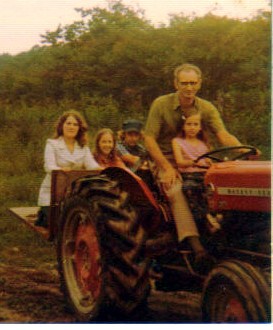
It’s not the back of the truck, but another fond memory on the farm with Dad. On the back: my cousin Debbie, sister Donna, and brother David (JD).

One of my fondest childhood memories is riding in the back of my dad’s truck. I remember being a lookout for a crop of tobacco I had spotted earlier that day, thinking Dad would like to see this field of tobacco. So, when he got in from work, I used my super girl skills to convince him to let me show him. The only problem was I couldn’t find it.

At the time, I was disappointed that something I thought I could connect with my dad was gone. But, looking back, I now have fond memories of riding in his truck, looking for the lustrous tobacco crop I could no longer locate. I now see that Dad took time away from resting after a long day’s work to appease my childhood whimsy.

He saw it as a time to spend with his kids.

My dad got up before dawn every day for 30+ years to drive an hour each way to work at IBM in Lexington. When he got home, he went to the farm to feed, water, and count the cows, besides whatever other chores I did not know about, such as mowing or grading the road with his tractor. And if we happened to be living at the farm (we had spent our summers there since I was nine), he still had to haul water down from our other house every evening because we didn’t have running water at the time. (We thought this was a big adventure – not seeing all the work Dad did to make it happen). I spent many days brushing my teeth with a cup of water and spitting off the side of the porch.

He wasn’t the only one who got up that early; for years, Mom got up with him to prepare a full breakfast before he left for work – at least until they changed their diet to heart-healthy oatmeal. I remember waking up many mornings to the sound of their not-so-quiet whispers in the kitchen. Perhaps the smell of homemade biscuits and gravy, sausage, and eggs awoke my senses to their breakfast chatter; either way, I see how they made time to spend a few minutes alone before we got up.

He did not have to get up that early. He could have grabbed something on the go and spent a few extra minutes in slumber, but he chose to connect with Mom during those early mornings, and she chose to get up with him and make breakfast and sip coffee from saucers in the wee hours of the morning. They found time to spend together in a five-room house full of kids. (Talk about tiny house living – we had no idea it would become popular).

It is those precious memories that aren’t soon forgotten.  I think that is the most important thing God asks of us – to spend time with our heavenly Father. All He wants is to spend time with His kids – and we are better off for taking the intentional time to connect. Sometimes, that may mean getting up a little earlier and being still before the hustle and bustle of our day begins. It is allowing His whispers to seep into our heart and mind awakening us to the sweet aroma of the bread of life that feeds our hungry souls.

Jesus replied, ‘I am the bread of life. Whoever comes to me will never be hungry again. Whoever believes in me will never be thirsty’ ” (John 6:35, NLT, emphasis added).

“Be still and know that I am God” (Ps. 46:10, Emphasis added).

Dose of Encouragement

Everyone can use a dose of encouragement regardless of age or how far we are on our journey.

One morning as I approached the mailboxes on the main street leading into my neighborhood, a gentleman stopped to make a deposit.

As I ran past, he kindly said, “Great job! Keep up the good work.” 

I thanked him and gave a thumbs up. But, as most things do, this reminded me that whether it is running, another sport, or our faith walk with Christ, at the beginning of our training, or a seasoned vet, we can all use inspiration to keep on going, press on, don’t give up.

As I ventured further, I met two other women running in the opposite direction. As my route winds back around, our paths crossed again, only this time they were walking.

As if to justify themselves, one girl said, “It’s hot! We’re from Ohio.”

Oh well, that explains it all…buckeyes. Only kidding. I paid the encouragement forward. But this reminded me of my trip to Austria a while ago. Climate change can make you uncomfortable and disconnected when in unfamiliar territory. I was out of my comfort zone on that trip, so many miles away from home, unable to have my usual quiet time and space. I was trying to find my rhythm on a new route, with new people to meet and work alongside.

Before I left, God gave me a few images: a sundial and Russian nesting dolls. Strange right? It didn’t make sense until I struggled to find peace and saw these images in Vienna. In those moments, I knew God was still with me and that He knew I would need these reminders.

Another time, on a church summer camp excursion with middle school girls, I desperately needed some time away from the chaos to reconnect with God. So, every chance I got, I stole a few minutes away on the other side of the lake to reset, recharge, and refresh my spirit to tackle another night. We all need these times to give us the strength to pour into the lives of others and not get burnt out.

“In returning and rest you shall be saved; in quietness and trust shall be your strength” (Is. 30:15, ESV, emphasis added).

“Encourage one another and build one another up” (I Thes. 5:11, emphasis added).

Distinctly Different

The platypus swam into my dreams a few years ago, leading me to research the creature. The design itself intrigues me. I decided to dig deeper into this bottom feeder and get insight into this remarkable mammal. Interestingly, according to LiveScience, their characteristics resemble that of many different species. Their bill and feet are like a duck, their tail is like a beaver, their feet, body, and fur resemble an otter, and their lizard legs sprawl out to the side of the body when they walk.

In addition, to this extravagant list, they are amphibious. When they are not using their webbed feet in the water to swim, they can retract the web exposing individual nails that allows them to run on land. They also lay eggs, one of only two mammals that do.

Although they do not have teeth and use their cheek pouches to hold food until they can mash it up and swallow it, they have sharp stingers on the heels of their rear feet to defend themselves, with a toxic venom that is quite effective when needed. They are non-life threatening but powerful enough to damage their victim significantly.

This hodgepodge creature has many features of other animals, but oddly enough, the familiar qualities make it unique and distinctly different from the rest. It can undoubtedly relate to the duck by how it uses its bill and webbed feet and the beaver by using its tail to maneuver through the water gracefully, and the otter and lizard by how it uses its feet to swim and run, awkward as it may be.

As children of God, we are given many distinctive qualities, although we can relate to one another because we are made in the image of our Creator. Each of us has gifts given especially to us. We have many of the same characteristics, and all of us, like sheep, have strayed away (Isaiah 53.6). God made us exactly how we are on purpose and saved us by His grace. We can accept everything just as it is – flaws and all. We see the blemishes through our eyes and want to make changes or compare ourselves with others. But if we could see ourselves as God sees us – through His love –we would be content with ourselves and thank God for each unique quality that makes us stand out from the rest.

Post a reminder on your mirror: God profoundly loves you as you are. No matter how we see ourselves, we can be confident in what God is doing in and through us. Obedience is key. We are protected by the armor of faith and love when we wear salvation’s confidence as our helmet (I Thes. 5:8, ESV).