God Yearns for You

Looking back at the beginning of my journey of becoming a Christ-follower, I realize that it was a process – I didn’t immediately change my old habits, although I wanted to be closer to God. This process of being freed from sin is called sanctification. After repenting and surrendering my life to Christ and asking God what He wanted, the Holy Spirit began to work on my heart. He began to mold and reshape me and my character. Not only did I not want to continue with the old habits, but the conviction was also so firm that I could not hide it.

As I wanted to be closer to God, my old ways and sins had to make way for Christ’s new creation to form. The two cannot co-exist if we make room for Christ and have the relationship He intends for us.  Peace comes when we stop allowing our loyalty to be divided between God and the world.

We can’t feel the closeness and relationship we desire if we are still straddling the fence. But when we go all in – wholly surrendered to Christ – that’s when it all comes together, and we feel His presence, even though He has not gone anywhere – He is always with us – we are the ones who pull away. Feeling distant from God has a direct correlation to our sins. Once we repent and let God’s grace wash over us, the relationship begins to form as we make more room for Him in our hearts.

James points out that it is impossible to please God and the world simultaneously (James 4:4). When we come close to God, He will come close to us (James 4:8). Straddling the fence only makes us miserable. These verses from James echo Jesus’ message – “No one can serve two masters. For you will hate one and love the other; you will be devoted to one and despise the other” (Matt. 6:24, Emphasis added). We must step closer to Him, knowing His arms are open to welcome us. He patiently waits for us to look in His direction and want His comfort. He is a jealous God who yearns for the spirit He placed within us to worship Him alone (James 4:5; John 4:23-24).

God never tempts us – temptation comes from our desires. God always offers a way out of sin and temptation (James 1:13-14). “Submit yourselves therefore to God. Resist the devil, and he will flee from you” (James 4:7, Emphasis added). We must learn to use our spiritual weapons against the devil by speaking Jesus’ name and bearing His armor (Eph. 6:10-18).

We can ask God to reveal anything we are holding on to and ask Him to help us remove it to make more room in our hearts His Spirit. David shows us how to do this, “Point out anything in me that offends you, and lead me along the path of everlasting life” (Ps. 139:24, New Living Translation, Emphasis added). Furthermore, he also gives us a prayer, “Create in me a clean heart, O God. Renew a loyal spirit within me” (Ps. 51:10, Emphasis added). A prayer I often recite.

Our goal should be to draw closer to God daily to allow more room in our hearts for His presence. I encourage you to take a step closer to God today and ask Him to help you yearn for His presence as He yearns for you. God wants to be your first love.


God’s Justice and Love Meet at the Cross

At first glance, some Old Testament stories of God’s wrath may be hard to swallow. In reconciling God’s character as a loving God, we must first put it into context and not single out one instance apart from the rest of the Bible, which displays His mercy in that He supplied the resolution through His Son, Jesus.

Human sin separated people from God. But He still wanted to be with them. How often do we read God’s Word in the OT, saying, “You shall be my people, and I will be your God” (Jer. 30:2, English Standard Version, Emphasis added)? The punitive righteousness of God was the only way. Righteousness itself is grounded in the character of God (Brand, 2015, 1673). Still, God is love. He incredibly displayed His radical love by giving His Only Son as a substitute for sin because He wants us to be in a relationship with Him. No matter what we have done – He still loves us immensely.

Like many today, the people in the Old Testament stories refused to believe in the Creator and worshipped creation – known as idolatry. Our objects of worship may look different, but it is the same old problem. We still put other people and things ahead of God. Unlike in those days, we now have hope in Jesus Christ, who stands in the gap, allowing us to be forgiven forever. Jesus Christ received the punishment we deserved, showing God’s abundant and deep love for His people.

The righteousness of God, as presented by Paul in Romans, shows how the character of God not only demands judgment for sin but supplies the answer to sin through Christ’s death and resurrection for all those who believe.  According to The Message of Romans, John Stott explains that Paul must defend God’s behavior and righteous character. “He is convinced that whatever God does – in salvation (3:25) or in judgment (2:5) – is consistent with his righteousness” (Stott, 2021).

God’s love toward His people calls for salvation through grace to enjoy a relationship with Him despite our sinful condition. His holiness demands an answer that only Christ could fulfill. In that fulfillment, His merciful love shines through and benefits us.

Therefore, God is not only the Just but also the Justifier, with an image at the cross where God’s justice and love meet (Rom. 3:26).

The best part is that we don’t have to wait to clean ourselves up and change our character – God wants us to come as we are – He will do the rest. He isn’t looking for perfection – He’s seeking a willing heart.

Bibliography

Brand, Chad., ed. Holman Illustrated Bible Dictionary, B & H Publishing, 2015.

Stott, John. The Message of Romans, InterVarsity Press, 2020. ProQuest E-book Central, http://ebookcentral.proquest.com/lib/liberty/detail.action?docID=6406189.

Purpose in the Pain

I look forward to spring flowers and sunny days kayaking in this season of cold and wintry conditions. Even though the first snow excites me, I miss running. There are reasons to appreciate all seasons. It is the same with life. I realize that if I had not been in the valley, at times, I might not have appreciated the mountaintop experiences as notably.

The valley also helps us learn to depend on God. It may seem the opposite of our nature, but thanking God during those seasons is beneficial. We can blossom even during the off-season if rooted in His Word, allowing it to cultivate the spiritual soil for ultimate growth.

Similarly, God designed the flower to reach its full potential through proper preparation. Its cycles are fascinating. Before we plant flowers, we must cultivate the soil and prepare it to receive the seed for ultimate growth. If the ground is too hard, the seed won’t take root.

The Avas Flowers site explains the cycles of a flower’s life:

Seed Stage: Every seed has a miniature plant that needs the proper nutrients to begin new growth. Some seeds can still grow after many years if they are correctly kept.

Germination: A seed in the earth will need warmth and water to grow. Some even need light at this stage. The seed will absorb water to split the outer shell, opening it up to a transformation as it begins to sprout a stem. The tiny root begins to push its way down as it grows. According to this article, seeds have different needs; some need to go through a fire to sprout, while others go through the stomachs of animals.

Growth: When the leaves begin to form, they convert energy from sunlight and water along with other nutrients to use as food. The root system uses the food to continue to develop, anchoring the plant into the ground, and uses root hairs to absorb water and nutrients. The stem is used to reach toward the light as it sends water and food to the roots and leaves. Then the buds begin to develop to later produce the beautiful blooms we so enjoy.

Reproduction: As the bud forms, it has a tiny but complete flower. Over time, the bud opens and blossoms into a mature flower.

Pollination: Flowers depend on insects, birds, animals, wind, and water to carry pollen from flower to flower. Without pollinators, they could not produce more seeds or new plant life. Even flowers that can’t make their pollen rely on and benefit from other plants during cross-pollination, resulting in more vigorous plants.

Spreading Seeds: This is the final stage in many ways. The wind can scatter the seeds, and the fur of animals, such as humans, water, etc., can carry the seeds to other locations. But a new plant life cycle begins once the seeds fall to the ground.

Consider the God-given design and the little details for a flower to grow, bloom, and thrive. Now, think about how we are designed. Cultivating the hard ground to prepare for the seed is like God cultivating our hearts – if it is still a hard and stony heart, the seed won’t take root. It must be rooted in fertile soil and be fed the right messages of His truth to grow to its full potential.

The roots send nutrients through the stem so it can stand firm to produce the bloom. We also need to be rooted deep in the Word to be fed and stand firm against the enemy to deliver the kind of fruit pleasing to the Creator.

The flower needs the sun’s light to flourish, just as we need the light of the Son in our lives. When we bloom where we are planted, God can use us no matter where we are if we stand tall and look to Him. He supplies the living water of the Spirit to nourish us and help us grow to our full potential into the beautiful bloom He created us to be.

We can grow better if we surround ourselves with suitable pollinators (Christian friends). At times in our lives when we cannot self-pollinate, we have others to lift us and help us through to the other side. It has been said that we are the average of the friends we hang out with the most. In that case, we need to find friends like what we want to become. Otherwise, we will be taken over by weeds, smothered, and eventually wilt.

There is a full- complete flower inside all of us waiting to bloom in the light of Christ’s love. Some of us go through the fire to get there; everyone goes through different experiences that lead us to Christ. But our life experiences help us relate, and we can share our story to assist others by spreading the seeds and message to direct others to Christ and, ultimately, the Kingdom.

Some of the most challenging seasons in our lives bless us and others the most, depending on how much we allow God to use them.

Food for thought:

What if the thing you are going through is preparing you for a bigger purpose?

Matthew 3:18-32

(Parable of the seeds)

Hope is Alive

God is real. Hope is alive in Christ.

Those following my journey know that my heart has been guarded for a long time. I hadn’t dated in almost ten years after coming out of an abusive relationship. After becoming a Christ-follower, I learned more about who I am – as God’s child and who He says I am, instead of listening to Satan’s lies.

I have been building on my relationship with God, learning to make better decisions (making decisions at all is a huge accomplishment), and more about myself, such as my favorite things. God also helped me set and achieve some incredible goals I never had in mind.

I have not hidden my story but allowed God to use it to help others. This blesses my life immensely and takes the edge off the painful experiences. I can testify to the fact that God is a Redeemer.  

I didn’t know if God was preparing someone for me – but a while back, I began to have hope that He was. A few years ago, God connected me with a woman in Florida named Dana, who is a counselor for women who have been abused. She had her own story to share – but what stuck with me is that she also told me there was hope. She had re-married a wonderful man who respected her, and she wanted me to know there were still good, godly men in this broken world.

Even though, for anyone who asked, I was not looking for a man, I realized in my heart that if God had someone for me, He would need to put them in my path and show me. It couldn’t be of my own doing but rather something of God beyond the shadow of a doubt. He did just that. Every step of the way, God has been abundantly clear with confirmations. Even when the enemy tried to steal my joy with doubts and fears – God restored peace in my heart and supplied a patient, prayerful companion to help me through it.

Hope is essential to our journey. It provides the ingredients needed for perseverance on our walk with Christ.

Through Faith Walk Ministries and the care group I lead, the Sister’s Circle, God allows me to share this hope with other women survivors, as Dana did for me. As you may have noticed, I have a new name – but more than that – I am excited to share that I have a wonderful new husband who respects me, loves Jesus, and prays with and for me…just a few things from my laundry list of requirements I told God about a few years ago.

The Bible supplies a filter for character traits to seek – I Cor. 13:4-8. If you have not read this lately, please do, but I will give you a few of them: Love is patient and kind; it does not envy or boast; it is not rude or arrogant and does not insist on its own way…love bears, believes, hopes, and endures all things.

There is hope. God redeems.

If you know anyone who could receive help from the Sister’s Circle support group, please share this blog and the link above for information about how to sign up.

“May the God of hope fill you with all joy and peace in believing, so that by the power of the Holy Spirit you may abound in hope” (Romans 15:13, English Standard Version, Emphasis added).

The Potter

The Potter

In the ancient world, a clay jar was likened to human weakness. Apostle Paul refers to the “knowledge of the glory of God in the face of Jesus Christ” (2 Cor. 4:6, English Standard Version) as a treasure in jars of clay (v.7). Standing for the principle of Christ’s crucifixion – God triumphs during human weakness.

Similarly, Isaiah refers to God as our Father – the Potter. At the same time, we are again seen as the work of His hand – the clay (Is. 64:8). Other references are made throughout the Bible as a vessel of clay, a broken vessel, and God as the shaping agent or Potter. Nevertheless, I was drawn to the story of Jeremiah when the word of the Lord came to him and told him to go to the potter’s house.

To set the stage, the book of Jeremiah is set at a time of political turmoil, following the fall of the Assyrians and the rise of the Babylonians. He saw the destruction of Jerusalem and the temple, with many Judeans deported to Babylon.

First, Jeremiah saw the potter working and shaping the clay on his wheel. The potter spoiled the clay and reworked it with his hands into another vessel that seemed promising. God then spoke to Jeremiah about the house of Israel. Likewise, God can reshape Israel (Jere. 18:4-5).

We are also a work of the Father’s hand. Since Christ came to redeem us from our sins, we can be reshaped into usable vessels to bring glory to God. God created and helped us in our weakness, like the clay jar. The Holy Spirit’s work within a believer has the power to transform our hearts for honorable use to further the Kingdom of God.

We cannot do this work on our own. Our most sincere desires to change old behaviors are limited if we don’t have the power of God’s Spirit within us. This requires surrendering to the Potter and allowing Him to do the work from the inside out. No matter how many times we change locations or jobs – without a heart transplant – our efforts to change are fruitless.

Isaiah supplies the secret to Judah’s strength. “In returning and rest, you shall be saved” (Isaiah 30:14). Returning means repentance. When we repent, there is a rest for our souls. He continues, “In quietness and trust shall be your strength” (v.15). This is the true path to victory and peace. In God alone, we find the strength to follow His path, but it requires repentance and trust. The Judeans refused and went their way. Many of us do the same and never experience the peace and joy of a life surrendered to Christ in obedience – and God’s will for us.

God knows best. His timing is always perfect. It is our impatience that doesn’t want to wait for His answers.

Love: Still the Most Important Thing

All sins separate us from God. One sin is not more important or worse than another. We tend to emphasize certain sins rather than see them all the same. We are all born sinners in a broken world because of Adam and Eve (The Bible. New Living Translation. Gen. 3: 1-24; Rom. 5:17). There is one sin, though, that we are encouraged to run from: sexual immortality (I Cor. 6:18) because it is against our bodies. Nevertheless, we are all traveling in the same boat in the same direction. Still, God’s grace is sufficient and redeems our sins when someone repents and accepts Jesus (Acts 3:19). This is because of His love for us.

Let us imagine for a minute that we are all on this proverbial boat I mentioned. We cannot navigate the treacherous waters alone. When we begin to sink, God’s love and grace, through His Son Jesus, throws us a life preserver. We can accept it, be saved, or reject it and continue to sail down the river of destruction in the boat of self-righteousness on a disaster course.

Once we repent of our sins and accept Christ, we are forgiven forever and receive the gift of the Holy Spirit (Acts 2:38), who guides us for the rest of our journey. We still have the temptation to sin, but with God’s help we can overcome them because we are victors in Christ (Col. 2:14). We are not to continue in our old life or return to the boat but be renewed every day to the likeness of Christ (Rom. 6:1-2).

We can also experience joy and a piece of His kingdom while we wait for our eternal home, but we are not meant to pursue happiness in this life as a destination. C.S. Lewis put it this way, “If you think of this world as a place intended simply for our happiness, you find it quite intolerable: think of it as a place of training and correction, and it’s not so bad” (Lewis 52). Happiness comes from our circumstances; joy comes from our relationship with Christ, regardless of our circumstances.

There are many different beliefs, and we do not all agree, but no matter what our neighbor believes, we are still called to love them (Lev. 19:18; Matt. 22:39; Rom. 13:8). In this way, we honor God. Above all else – we are to love God first. When our priorities are correctly aligned, it becomes easier to love others as we see them in God’s image (Gen. 1:27; 2 Cor. 3:18).

“We love each other because he loved us first” (I John 4:19, emphasis added).

Works Cited

Lewis, C.S., God in the Dock. Eerdmans, 1994.

The Bible. NLT Study Bible. New Living Translation Version. Tyndale, 2008.

Storms

As a child, I was terrified of thunderstorms, as most kids are. I knew someone a little older than me who loved to see a storm brewing in the midst. With nose pressed to the pane, he delighted in watching the strikes pierce the night as they danced across the moonless sky. But not me. I buried my head as deep underneath the covers as I could, no matter how hot. Mom hung blankets over the windows to block out the lighting, but that didn’t keep the thunder from penetrating my ears.

These days, I am more drawn to the window to see God’s handiwork. I welcome the storms, in a strange turn of events, especially at night. The flashes and rolling thunder remind me that God is in control, which comforts me. I no longer need to cover the windows. If I were the one in control, there would be reason to bury my head.

We can respond the same way when life’s storms come. Even as Christ-followers, we are not exempt from the pains in this life. Sometimes we want to bury our heads. But we can rely on God to see us through the storms because He is still in control no matter what happens. That brings comfort, even through fearful times.

He is a good Father who provides shelter, but He also disciplines us for our good and supplies us with a way back when we stumble. God is not watching and waiting for us to mess up so He can waggle His finger at us or punish us. He wants the best for us. He longs for us to come to Him.

He is our Rock, Fortress, and Deliverer (2 Sam. 22:2, ESV; Col. 1:13), Way-maker and Way-forward, Strength, Shield (Ps. 28:7), Rescuer (Acts 12:11), Shepherd (Ps. 23:1), Promise Keeper (2 Cor. 1:20), Redeemer (Job 19:25), Lord and Savior (2 Peter 1:11), Steadfast Anchor (Heb. 6:19), Hope in the dark (Rom. 15:13), Safe Haven (Ps. 36:7), and the Giver of every good and perfect gift (James 1:12) and that is just the beginning. His arms are wide open, waiting for us to run into them with childlike wonder. It is there that we find complete rest.

“Come to me, all of you who are weary and carry heavy burdens, and I will give you rest” (Matt. 11:28, NLT, emphasis added).

Kairos Moments

(A time when conditions are right for accomplishing a crucial action: the opportune and decisive moment – Merriam-Webster)

I can look back over my life and see times when I was at a crossroads. These Kairos moments were critical. I could choose life or death. I didn’t realize they were such desperate choices then, but they were. There were two pivotal moments in my life when I could pinpoint where a decision had to be made – for the first one – the devil was in my ear. Newsflash – the devil is a liar! It coincides with the beginning of the year I had dreaded since childhood. Maybe God was trying to warn me, but I chose the wrong path and dove deeper into darkness: keeping secrets, telling half-truths (which are a lie), and panic attacks that took my breath in the middle of the night; I cried myself to sleep more times than I can count. Bottom line: I was miserable, and it only got worse.

I often chose the wrong path, which I now know led to a type of death – loss of self-worth, my identity, and self-control, and I took on lots of fear and shame because of it. It led to my darkest moments when I put a man in the seat only God is to hold in my life and heart. I now know my identity is only found in Christ as a daughter of the King. I have no reason to fear – perfect love casts out fear (I John 4:18, ESV).

I wasn’t rooted in God’s Word and steeped in His love then. But when I hit rock bottom – broken in every sense of the word – a broken heart, bones, mind, and spirit. That is when Crossroads # 2 presented itself, only this time – I chose God! It was the first time I asked God what He wanted. I surrendered to His will and went all in. It is the best decision I have ever made. I have repeatedly had to tell the devil to take a hike since. There is spiritual warfare and a battle that can only be fought with the help of spiritual weapons (armor of God), the Holy Spirit, and the mighty name of Jesus. I had to renounce soul ties, destroy strongholds, and claim my inheritance as God’s child. In the words of David, God’s Word is a lamp to guide my feet and a light for my path (Ps. 119:105).

Have you ever thought about the crossroads you met over the years? Maybe you are at one now.

What are three things you would tell yourself if you could? I would say to myself:

  1. The devil is a liar (John 8:44, ESV).
  2. Don’t settle for anything less than God’s best.
  3. You can have a relationship with God and learn to put Him first.

Let’s take a moment to unpack those. First, Jesus said, “I am the way, the truth, and the life” (John 14:6, emphasis added). He tells the Jews who had believed in him, “If you abide in my word, you are truly my disciples, and you will know the truth, and the truth will set you free” (John 8:32, emphasis added). They question him about being a slave. In verses 34-36, he explains that everyone who practices sin is a slave to sin, but the Son (Jesus Christ) can free you. The devil would like us to think the opposite. He can twist the truth to appeal to the flesh and make us feel free to do as we please with our bodies, which leads me to number two. 

Not settling for anything less than God’s best means not compromising integrity for momentary pleasure. It is not worth it, and it leads to death. The Cambridge Dictionary defines integrity as the quality of being honest with strong moral principles. God always wants the best for us. God must be our biggest desire, which leads me to number three.

I always believed in God, even as a child. But I didn’t know how to have a relationship with God or understand how my little heart could love Him more than my family. Learning to put God first in my life was life-changing and improved all my other relationships. Because of my love for the Father and His love for me, I can love others better. When we align our hearts’ desires with God’s desires for us and not only believe but accept Christ as God’s Son and our Savior, everything else falls into place. There will still be pain and heartache (John 16:33), but Jesus Christ will be with us to help us through those times (Matt. 28:20). He sends the Holy Spirit to live in our hearts to comfort and guide us, a gift from God (Acts 2:38).

These two verses (Ps. 37:4; Matt. 6:33) go hand in hand: If we can learn to seek the kingdom of God first and foremost, our biggest desire is God, and our hearts are filled with His love, which leads to unspeakable joy. Even when this broken world delivers terrible news and death, there is always life-sustaining Good News that leads to eternal life as we wait expectantly for Christ to return.

When we seek God will all our heart, we will find Him (Jere. 29:13). Just as the Good News of Jesus is like cold water to a thirsty soul, a righteous person who chooses sin muddies a spring – evil pollutes a person’s way (Prov. 25:25-26).

We cannot keep beating our drums to the world’s rhythm and expect a new song to form in our hearts.

Next time you find yourself at a crossroads, I encourage you to choose the life Christ offers. It is worth it. You are worth it. Christ died so we could live.

“Delight yourself in the Lord, and he will give you the desires of your heart” (Ps. 37:4, ESV, Emphasis mine.)

“Seek first the kingdom of God and his righteousness, and all these things will be added to you” (Matt. 6:33, ESV, Emphasis mine.)

U-turns Allowed

I recently saw a flock of geese in full-on V formation flying overhead. There were about twenty of them. But, instead of continuing their current path, they managed to do a complete 180 and head in the direction they had just come from; they made a U-turn. I started thinking about the leader. Did he make a mistake in which direction he was taking them? As the rest of the clan followed the leader, how would they know they were on the right path?

This reminded me of my dad. When we went on car rides as a family, we quickly realized that he panicked easily if he thought he missed his turn. The first time we saw this in action, we were headed to the farm after supper, and Mom made a plate for our neighbor, Mr. Hall, something she often did. She told Dad to stop on our way so she could drop off the plate of food.  His house was just around the curve from ours, but Dad had already forgotten. So, just as we began to pass up the driveway, Mom yelled that he missed his turn. Dad slammed on the brakes, and we were rear-ended. This is the first time I recall hearing the term whiplash after my sister Donna’s neck began to hurt.

My siblings and I were sitting in the backseat of our turquoise 1966 Chevy Impala, and with Mom in the front seat, we didn’t get the benefits of her instinctive arm that naturally came across the waists of anyone sitting in the front seat when she was driving. Mr. Hall’s supper ended up all over the inside of the car and us.

After that, Mom learned not to yell when Dad missed turns. The next time we were riding along, and he passed up our turn-off, I remember her calmly turning to him in a monotone voice, saying something like – I think we were supposed to turn there. Panic still ensued, but at least he didn’t slam on the brakes; instead, he began nervously looking for a place to make a U-turn.

As I meandered around the neighborhood, continuing my run that morning, I saw a neighbor walking their dog. When the dog saw me, it wanted to run with me, but the owner, not so much. She guided the dog back to their path with a slight leash tug.

We all go down the wrong path occasionally and make poor decisions, sometimes running off on a whim without consulting God about which direction to take. We may even panic when we realize we are on the wrong path and have made a mess of our lives and caused damage to ourselves and others.

God’s grace not only gives us the space to make a U-turn but helps us clean up the mess and offers complete restoration to heal any damage that occurred while on our hiatus from the path God intended. Thankfully, God is patient with us. We, too, need to be tethered to Christ and let the Holy Spirit guide our hearts instead of allowing our hearts to lead us. The ultimate healing is only found in a relationship with Christ. It is not too late to make a U-turn.

“The heart is deceitful above all things and desperately sick; who can understand it?” (Jeremiah 17:9, ESV, emphasis added)

Intentional Connections

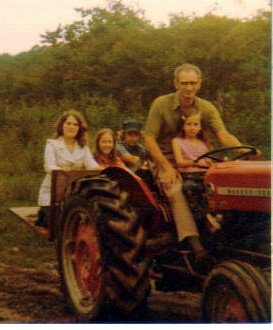
It’s not the back of the truck, but another fond memory on the farm with Dad. On the back: my cousin Debbie, sister Donna, and brother David (JD).

One of my fondest childhood memories is riding in the back of my dad’s truck. I remember being a lookout for a crop of tobacco I had spotted earlier that day, thinking Dad would like to see this field of tobacco. So, when he got in from work, I used my super girl skills to convince him to let me show him. The only problem was I couldn’t find it.

At the time, I was disappointed that something I thought I could connect with my dad was gone. But, looking back, I now have fond memories of riding in his truck, looking for the lustrous tobacco crop I could no longer locate. I now see that Dad took time away from resting after a long day’s work to appease my childhood whimsy.

He saw it as a time to spend with his kids.

My dad got up before dawn every day for 30+ years to drive an hour each way to work at IBM in Lexington. When he got home, he went to the farm to feed, water, and count the cows, besides whatever other chores I did not know about, such as mowing or grading the road with his tractor. And if we happened to be living at the farm (we had spent our summers there since I was nine), he still had to haul water down from our other house every evening because we didn’t have running water at the time. (We thought this was a big adventure – not seeing all the work Dad did to make it happen). I spent many days brushing my teeth with a cup of water and spitting off the side of the porch.

He wasn’t the only one who got up that early; for years, Mom got up with him to prepare a full breakfast before he left for work – at least until they changed their diet to heart-healthy oatmeal. I remember waking up many mornings to the sound of their not-so-quiet whispers in the kitchen. Perhaps the smell of homemade biscuits and gravy, sausage, and eggs awoke my senses to their breakfast chatter; either way, I see how they made time to spend a few minutes alone before we got up.

He did not have to get up that early. He could have grabbed something on the go and spent a few extra minutes in slumber, but he chose to connect with Mom during those early mornings, and she chose to get up with him and make breakfast and sip coffee from saucers in the wee hours of the morning. They found time to spend together in a five-room house full of kids. (Talk about tiny house living – we had no idea it would become popular).

It is those precious memories that aren’t soon forgotten.  I think that is the most important thing God asks of us – to spend time with our heavenly Father. All He wants is to spend time with His kids – and we are better off for taking the intentional time to connect. Sometimes, that may mean getting up a little earlier and being still before the hustle and bustle of our day begins. It is allowing His whispers to seep into our heart and mind awakening us to the sweet aroma of the bread of life that feeds our hungry souls.

“Jesus replied, ‘I am the bread of life. Whoever comes to me will never be hungry again. Whoever believes in me will never be thirsty’ ” (John 6:35, NLT, emphasis added).

“Be still and know that I am God” (Ps. 46:10, Emphasis added).