Hope is Alive

God is real. Hope is alive in Christ.

Those following my journey know that my heart has been guarded for a long time. I hadn’t dated in almost ten years after coming out of an abusive relationship. After becoming a Christ-follower, I learned more about who I am – as God’s child and who He says I am, instead of listening to Satan’s lies.

I have been building on my relationship with God, learning to make better decisions (making decisions at all is a huge accomplishment), and more about myself, such as my favorite things. God also helped me set and achieve some incredible goals I never had in mind.

I have not hidden my story but allowed God to use it to help others. This blesses my life immensely and takes the edge off the painful experiences. I can testify to the fact that God is a Redeemer.  

I didn’t know if God was preparing someone for me – but a while back, I began to have hope that He was. A few years ago, God connected me with a woman in Florida named Dana, who is a counselor for women who have been abused. She had her own story to share – but what stuck with me is that she also told me there was hope. She had re-married a wonderful man who respected her, and she wanted me to know there were still good, godly men in this broken world.

Even though, for anyone who asked, I was not looking for a man, I realized in my heart that if God had someone for me, He would need to put them in my path and show me. It couldn’t be of my own doing but rather something of God beyond the shadow of a doubt. He did just that. Every step of the way, God has been abundantly clear with confirmations. Even when the enemy tried to steal my joy with doubts and fears – God restored peace in my heart and supplied a patient, prayerful companion to help me through it.

Hope is essential to our journey. It provides the ingredients needed for perseverance on our walk with Christ.

Through Faith Walk Ministries and the care group I lead, the Sister’s Circle, God allows me to share this hope with other women survivors, as Dana did for me. As you may have noticed, I have a new name – but more than that – I am excited to share that I have a wonderful new husband who respects me, loves Jesus, and prays with and for me…just a few things from my laundry list of requirements I told God about a few years ago.

The Bible supplies a filter for character traits to seek – I Cor. 13:4-8. If you have not read this lately, please do, but I will give you a few of them: Love is patient and kind; it does not envy or boast; it is not rude or arrogant and does not insist on its own way…love bears, believes, hopes, and endures all things.

There is hope. God redeems.

If you know anyone who could receive help from the Sister’s Circle support group, please share this blog and the link above for information about how to sign up.

“May the God of hope fill you with all joy and peace in believing, so that by the power of the Holy Spirit you may abound in hope” (Romans 15:13, English Standard Version, Emphasis added).


The Uncomfortable Comforter

A few years ago, I was in the waiting room at the doctor’s office when an older man in a wheelchair came in. He was sitting across the room from me and began talking out loud – to nobody in particular – and anyone who might listen. Most people ignored him.

He was questioning why God still had him in this world. Then he said, “All I ever wanted was somebody to love me.” The Holy Spirit nudged me, and I headed over and sat in the empty chair beside him, smiling, unsure what to say. It is better to let the Holy Spirit guide my words; all I had to do was be willing to go. That way, God gets all the glory.

I said, “God loves you.”

That opened a door for him to tell me more about his relationship with the Holy Spirit, whom he fondly called the Comforter. He remembered times when he sat alone with the Good Book and felt the presence of the Holy Spirit with him. He shared that he had tried to tell his dad about the Comforter, but he wouldn’t listen. I knew God put me there for a reason – to remind him of his Father’s love and to bring peace.

In explaining the Holy Spirit to the disciples before His ascension, Jesus describes Him as the Helper, whom the Father will send to bring remembrance to everything Jesus told them. He follows that promise with another – peace (John 14:25-27 English Standard Version).

When we remember what Jesus taught about how to conduct ourselves and strive to obey the Father and His will – peace follows. Paul admonishes us to stay in step with the Holy Spirit (Gal. 5:25).

Still, an uncomfortableness is also associated with the Holy Spirit that comes when we are out of God’s will and away from obedience. This conviction is necessary for any true transformation in our lives and hearts. The continual process of sanctification helps us become more like Jesus.

If we are never uncomfortable, we won’t have the motivation to change. This is by the design of our Heavenly Father. It is also true for our children. In a recent group meeting, a friend and respected mentor shared his philosophy – if he teaches his kids to love Jesus and put Him first, he knows the rest will work itself out. He recommended the book Parenting by the Book by John Rosemond, which discusses making your kids uncomfortable to initiate desired character traits and positive changes. If you are a parent of a pre-teen or teenager, I highly recommend you check it out or share it with someone who is. We are not doing them any favors by not allowing them to be uncomfortable.

The Blessing

On this day of Thanksgiving, I am reminded of two songs. We Gather Together is a 17th-century Dutch song I remember singing in elementary school, along with The Blessing, with the lyrics taken directly from the Bible. The words to the first song below seem to set up the intentions of the second perfectly.

We gather together to ask the Lord’s blessing; He chastens and hastens his will to make known. The wicked oppressing now cease from distressing. Sing praises to his name; he forgets not his own.

With this in mind, take a moment to listen to The Blessing – let the words wash over you and sink into your heart.

“The Lord bless you and keep you; the Lord make his face shine upon you and be gracious to you; (V 26) the Lord lift his countenance upon you and give you peace.” (Numbers 6:24-26, English Standard Version, Emphasis mine)

Aaron’s priestly blessing shows God’s will to bless every Israelite. The ESV Study Bible denotes that this blessing engraved on a silver amulet is the earliest archaeological discovery, having the covenantal name of God (Yahweh), found in a Judean tomb dating back to the seventh or sixth century B.C.

Let us look at the meaning of each verse: The Lord blesses us by giving good harvests, peace, children, and his presence (Lev. 26:3-13). ‘Keep’ means to guard or protect. His face shines upon you in God’s presence, like sunshine (Ps. 19:1-11). A shining face is a smiling face, a pledge of God’s good favor (Ps. 80:3, 7, 19, ESV). The countenance is the expression on one’s face. The Study Bible says that for God to lift His face, He must treat people favorably. Peace or shalom means total well-being.

This led me to Daniel 9, which provides the same model of repentance and prayer along with this blessing. Daniel prayed a prayer of adoration, then a confession on behalf of himself and his people (9:4). Daniel asked God to show favor, make His face shine upon him, and bring exile to an end. Not because of his righteousness but because of God’s commitment to glorify His name (9:17). If we read further, Daniel received an answer from God through an angel named Gabriel. Still, I want us to pay attention to this: he confessed his sin and the sin of his people, presenting a plea to God and asking for His blessing.

As we gather to give thanks, I want you to know how thankful I am for each of you. I pray that you will receive God’s blessing and remember to thank Him every day for the blessing of Jesus Christ – the reason for the upcoming season – not only today but every day.

Be kind. Be safe. Be blessed.

Predestination: The Search for Answers

I grew up in a family with a long line of Primitive Baptist ministers; my dad was one of them. Predestination is a prominent doctrine rooted in Calvinism, taught, and handed down for generations. The idea is that God chose people destined to be saved before they were born, or as defined in the Holman Illustrated Bible Dictionary, “To decide upon beforehand.”

This is the subject of many debates even before John Calvin. The opposition argues for free will. But when I did my research, I traced it back to Calvin, whose central theme in all his writings was the Sovereignty of God, which is where his beliefs in predestination are rooted. The Sovereignty of God refers to the biblical teaching that God is all-powerful and rules all things (Ps. 135:6; Dan. 4:34-35). Furthermore, “Scripture emphasizes God’s rule in three areas: creation (Gen. 1; Mark 4:35-41; Rom. 8:20-21), human history (Judg. 14:1-4; Prov. 16:9, 33; Ps. 22:28; Hab. 1:6; Acts 17:26), and redemption (John 17:2; Rom 8:29-30; Eph. 1:3-14; 2 Thess. 2:13-14; 2 Tim. 1-9-10)” (Brand, 2015).

Paul writes in Romans 8:29, “For those whom he foreknew he also predestined to be conformed to the image of his Son.” Likewise, in Ephesians 1:5, Paul again teaches, “In love, he predestined us for adoption to himself as sons [and daughters] through Jesus Christ, according to the purpose of his will.” Paul also quotes the Old Testament: “Then Isaiah is so bold to say, ‘I have been found by those who did not seek me; I have shown myself to those who did not ask for me’ ” (Rom. 10:20, English Standard Version). Talking about Israel, he continues that God held out His hands to disobedient people (v 21). What stood out to me was both sides of the coin being taught. Since the Bible is not contradictory, we must reconcile these passages.

The prophecy of Isaiah has been fulfilled; Gentiles who did not seek God have experienced God’s saving promises. Israel may have been disobedient, but God still extends His hand to them, inviting them to be saved. On the one hand, God predestines some to be saved; on the other hand, He still longs for others to be saved. Though it may seem impossible, both statements are correct. It is not a black/white either/or camp – putting limits on God – instead, there is a both/and concept to consider. I am not talking about moral teachings, which are non-negotiable; I am not debating that here. I am talking about doctrines on one’s salvation – both focused on grace. The issue is our ability to choose by free will. Humans can make willing choices that have actual consequences, good and bad. Notwithstanding God’s sovereignty, humans are still accountable to God for their actions (Rom. 2:5-11; 3:19). Paul raises the problem, but rather than resolving the tension, he affirms both (Brand, 2015).

I believe God chose me for this mission, preparing me for such a time as this (Esther 4:14). Still, I had a choice. God does no evil nor approves of it. Nevertheless, He can use it for the good of His children and the fulfillment of His purposes (Brand, 2015). When I hit rock bottom – in my darkest hour – God brought me to Himself through a tragic year. We must also tell others about Christ so they can be saved (Rom. 10:14).

I spent most of my life in church but never received spiritual discipleship. Nor did evangelism surface because if one was predestined to be saved, there was no need in their mind. Predestination does not negate the necessity for human repentance and faith; it shows the possibility for both. God has chosen the foolishness of preaching to awaken faith in the elect (I Cor. 1:21). But He offers the Gospel to everyone without exception, hoping for them to be saved. The Holman Illustrated Bible Dictionary states that the same God who predestines also sends His laborers into the harvest to carry out His purposes. There is no grain of justification to slack on evangelism – sinners would never be saved without preaching (Brand, 2015).

Additionally, although it is possible to be chosen by God, it is not based on anything God saw in the person. It is solely according to His purpose, unknown to human wisdom, so a people of the great multitude will be with Him in His eternal kingdom (Rom. 8:29-30; Eph. 1:3-6,11). The ESV Study Bible notes that God’s predestination comforts His people because they are assured that all who come to Christ do so through God’s enabling grace and appointment. Even though Paul affirms in Eph. 1:11 that every event that occurs has some sense of being predestined by God – it is also true that human responsibility is an essential factor.

Paul and other biblical writers never blame God for tragedies and evil (Rom. 5:12; 2 Tim. 4:14; Job 1:21-22). Paul believed that personal evangelism and making conscious choices to obey God are necessary to fulfilling God’s plan. God planned the redemptive work of salvation through the death of Christ. However, those who killed Jesus did it of their own free will and evil intentions, not ordained by God, and will be held accountable for their crimes (Acts 4:28; 2:22-23; Rev. 13:8, Brand, 2015). Even as divine predestination is affirmed, so is spreading the Gospel to save others (Matt. 28:19; Mark 16:15). This is one of God’s mysteries to embrace.

The Sovereignty of God and human responsibility work together in the world, even if no one can fully understand it (ESV Study Bible). Brian Han Gregg points out in What Does the Bible Say about Suffering? God does not call one to trust in their understanding of Him, but He does call them to trust Him.

“For now, we see in a mirror dimly, but then face to face. Now I know in part; then I shall know fully, even as I have been fully known” (I Cor. 13:12, emphasis added).

“For my thoughts are not your thoughts, neither are your ways my ways, declares the Lord” (Is. 55:8, emphasis added).

Color and Light

The Holy Spirit sometimes prompts me to discover the characteristics and design of God’s creatures. I recently dug up some information when the sea urchin drifted into my quiet time. Oregon State University places it as one of the oldest animals on Earth. Also known as the porcupine of the sea, the red sea urchin can live to be a hundred. They range in various colors, from green, purple, red, brown, and more. Urchin means hedgehog; you can see a resemblance. Cape Clasp says that sea urchins use their entire body to respond to light without a bone in their body and no obvious eyes. Even their feet aid them. ThoughtCo.com explains that their mouths have multiple jaws and a chewing structure known as Aristotle’s lantern. Their body has a protective cover made from a shell-like system called a test.

            I find their God-given design fascinating, but what struck me the most was their response to light with their whole body. In the ocean’s depths, you may think it is complete darkness. Still, watching Welcome to Earth, hosted by Will Smith on the National Geographic channel, I discovered that the ocean floor is gleaming with light and color, especially at night. To understand the natural chemical process called bioluminescence, Good Living expounds that it illuminates the water like dazzling stars in multiple colors, allowing living things to produce light in their bodies.

            Color and light are related in many ways. We could say we are God’s prism. His light shines into our lives, illuminates us, and reflects into others’ lives, adding colorful blessings. Jesus is the light of the world (The Bible. English Standard Version. John 8:12). He adds color and light to our lives. The Hollman Illustrated Bible Dictionary says Christ’s light expresses grace and truth (1018).

            Turning to colors, white symbolizes purity and joy, red stands for sin or Christ’s blood, and black is usually linked with judgment or death. Purple was a prominent color used to dye garments, such as a robe that Christ and other priests wore in the Tabernacle. Colossae got its name from a Latin word meaning “purple wool” because the area produced and dyed wool (Brand 317).

            There are several similarities between light and color compared to Jesus and our lives. However, returning to the sea urchin, this exciting creature symbolizes our lives, with Christ at the center. Putting Him first, we will naturally gravitate toward His light. We do not have to see Him to feel His presence. He gives us Spiritual armor to wear for protection, with zeal as a cloak, so we can clothe ourselves with Christ (Is. 59:17). We can trust God to lead us through the dark when we feel like we are underwater. His light will guide us. There is a guaranteed inheritance for all who believe in Him. He seals us (protects and preserves) with the promise of the Holy Spirit until we gain possession of it (Eph. 1:13).

“Arise, shine, for your light has come, and the glory of the Lord has risen upon you” (Is. 60:1, emphasis added).

God’s Masterpiece

If you have ever hunted for sea glass at the beach while on vacation, you know that it can be a fun pastime, and sometimes it is hard to find. When you find a piece, it is worth the effort. But have you ever thought about how long it takes to form? According to an article by the science website Geology Page, it can take thirty to forty years, or in some cases, a century.

The saltwater weathers the colored glass and adds to the design, giving it a frosted appearance. Many people use it to make jewelry and other unique art pieces. However, it started much differently. It takes time to be a finished and stunning work of art. It likely began as a jagged piece of broken glass from a beverage bottle or other discarded item. You could say it was just a piece of garbage that spent years tumbling around in the water. It was rough around the edges and painful if you cut yourself with it. 

Given our broken nature, this is how we start. Our hearts are rough around the edges, and we cause others pain. Others sometimes discard us as trash, and we end up in a sea of troubled waters. Then God lifts us out of the mire, just as we are. He begins to shape us and smooth out our rough edges. However, like sea glass, it takes time; we are a work in progress – God’s masterpiece. He created us in His image (The Bible. English Standard Version, Gen. 1:27). Although we are not perfect because of sin (Gen. 3:6), He wants us to strive to be more like Jesus.  However, not in our performance (Titus 3:5; Rom. 11:6) but in how we love God and people (Matt. 22:37-39). The Hollman Illustrated Bible Dictionary notes that our good works are insufficient to earn our salvation but will naturally flow from a life of saving faith in Christ (Brand 1669).

Our lives are like shards of brokenness awaiting transformation only accessible through our Savior, Jesus Christ. Like sea glass, sometimes we tumble and fumble around for years before we begin to take shape, as God forms our character and helps us become a beautiful piece of art that the Master delights in blessing so we can be a blessing to others.

“Therefore, if anyone is in Christ, he is a new creation. The old has passed away; behold, the new has come” (2 Cor. 5:17, emphasis added).

“Jesus said to him, ‘I am the way, and the truth, and the life. No one comes to the Father except through me’ ” (John 14:6, emphasis added).

Peter’s Denial

Would you want to be in Peter’s shoes when he realizes Jesus’ prophetic prediction of his denial has just come true? Peter’s famous last words to Jesus, as we read them in the book of Mark, were, “If I must die with you, I will not deny you” (The Bible, ESV Study Bible. English Standard Version. Mark 14:31, emphasis added). Jesus had just told Peter that he would deny Him not just once but thrice that night before the rooster crowed twice (Mark 14:30). Jesus predicted Peter’s denial of Him.

Peter boasted of his loyalty before danger struck. Still, sure enough, when push came to shove, Peter felt fear sweep over him as he warmed himself by the fire. While Jesus was being questioned, spit on, and beaten – he denied knowing Jesus. Just then, a rooster crowed, and then again, he denied it, and the third time, he swore that he did not know Jesus. Each denial is more intense, but he recoiled when the rooster crowed for the second time. Saddened, Peter remembered the words of Jesus at that moment and wept bitterly when he realized what he had done (Mark 14:66-72). His betrayal probably made him think of himself as another Judas. We must remember that his treachery had happened just moments before. Peter may fear that he cannot be forgiven considering what Jesus said: whoever denies Him, He will deny before the Father (Matt. 10:33).

Nevertheless, as we read in the book of John, after Jesus’ resurrection, upon finishing breakfast, Jesus takes Peter aside for a private conversation. He asks him three times if he loves Him, each more intensely. Does that sound familiar? Peter gets frustrated and hurt by Jesus’ questioning, but each time, we see Jesus asking Peter to feed and tend to His lambs and sheep (John 21:15-17 emphasis added). Through everything, Jesus knows Peter needs restoration. He offers grace, letting Peter know He has forgiven him and that God can still use him for Kingdom work (Osborne 291).

Today, we can all say we have fallen short and sometimes betrayed or denied Jesus. Still, in His grace, God offers restoration and opportunities to use us to further the Kingdom by feeding His sheep, although He does not need us to complete His mission. What a blessing that He chooses to use us. I pray we turn to Him in repentance when we fail so our fellowship with Christ can be restored.

Works Cited

Osborne, Grant R. Mark, Baker Books, 2014. ProQuest Ebook Central, https://ebookcentral.proquest.com/lib/liberty/detail.action?docID=3425695.

The Bible. ESV Study Bible. English Standard Version. Crossway, 2001.

The Mayfly

After I became an unattached woman for the first time in my adult life, I realized I needed to figure out what I wanted to do and who I was instead of riding on the coattails of others. I was never good at making decisions, but being single forced me to change. My relationship with God plays a huge role in the decisions I make, along with knowing who I am and whose I am – as a child of God.

Since my bucket list became more prominent after my accident, I began to take trips alone to check them off. This season in my life was empowering and eventful. I did more in a couple of years than in my lifetime. Things I once feared and thought I would never be able to do by myself. One of those things was fly fishing in a creek – with waders – I was too excited about the waders. I have written about my experience before, but a recent writing class assignment brought back one detail of that trip that made a big impression—the mayfly.

While in the creek, I listened closely to my guide, and I remember his making a point to show me a mayfly that landed gracefully on his arm as I caught fish. He seemed honored to witness its presence, explaining that their lifespan is so short that they only make it a few hours to a day at most. It made an impression at the time, but I had recently researched the elusive creature in Encyclopedia Britannica when I was tasked with writing a poem and needed fresh inspiration.

Living their one short life fully with one task – laying thousands of eggs for the next generation – stood out to me as a purposeful mission we can learn from. They also indicate a clean water supply as they cannot survive in polluted waters. They begin their lives as larvae at the bottom of the creek bed and go through as many as twenty life stages before emerging above the surface to spread their wings for a day, lay eggs, and die.

The slippery rocks in the stream I was navigating represent how easy it is to fall back into the same patterns and pitfalls the enemy tries to trap us. Just as I had a guide leading me through the creek, God guides us and provides us with sure-footed steps to hold us up through treacherous waters. The mayfly represents living in the moment. What if, in our lives, we lived a purpose-filled life for Christ with our one life as intended?

I hope you enjoy the poem:

A Purpose-Filled Life

A mayfly’s passing life,

An instance to behold.

Emerging in a debut flight,

Testing new wings spread wide.

With purpose and poise,

One life to live – a moment in time.

Like raindrops dancing across the sea,

A legacy of eggs deposited in a creek.

Warm rays piercing translucent wings,

On the cusp of living,

Life ends nearly before it begins.

A brief hello, a brief goodbye,

With a final bow.

A purpose-filled life – one moment in time.

U-turns Allowed

I recently saw a flock of geese in full-on V formation flying overhead. There were about twenty of them. But, instead of continuing their current path, they managed to do a complete 180 and head in the direction they had just come from; they made a U-turn. I started thinking about the leader. Did he make a mistake in which direction he was taking them? As the rest of the clan followed the leader, how would they know they were on the right path?

This reminded me of my dad. When we went on car rides as a family, we quickly realized that he panicked easily if he thought he missed his turn. The first time we saw this in action, we were headed to the farm after supper, and Mom made a plate for our neighbor, Mr. Hall, something she often did. She told Dad to stop on our way so she could drop off the plate of food.  His house was just around the curve from ours, but Dad had already forgotten. So, just as we began to pass up the driveway, Mom yelled that he missed his turn. Dad slammed on the brakes, and we were rear-ended. This is the first time I recall hearing the term whiplash after my sister Donna’s neck began to hurt.

My siblings and I were sitting in the backseat of our turquoise 1966 Chevy Impala, and with Mom in the front seat, we didn’t get the benefits of her instinctive arm that naturally came across the waists of anyone sitting in the front seat when she was driving. Mr. Hall’s supper ended up all over the inside of the car and us.

After that, Mom learned not to yell when Dad missed turns. The next time we were riding along, and he passed up our turn-off, I remember her calmly turning to him in a monotone voice, saying something like – I think we were supposed to turn there. Panic still ensued, but at least he didn’t slam on the brakes; instead, he began nervously looking for a place to make a U-turn.

As I meandered around the neighborhood, continuing my run that morning, I saw a neighbor walking their dog. When the dog saw me, it wanted to run with me, but the owner, not so much. She guided the dog back to their path with a slight leash tug.

We all go down the wrong path occasionally and make poor decisions, sometimes running off on a whim without consulting God about which direction to take. We may even panic when we realize we are on the wrong path and have made a mess of our lives and caused damage to ourselves and others.

God’s grace not only gives us the space to make a U-turn but helps us clean up the mess and offers complete restoration to heal any damage that occurred while on our hiatus from the path God intended. Thankfully, God is patient with us. We, too, need to be tethered to Christ and let the Holy Spirit guide our hearts instead of allowing our hearts to lead us. The ultimate healing is only found in a relationship with Christ. It is not too late to make a U-turn.

The heart is deceitful above all things and desperately sick; who can understand it?” (Jeremiah 17:9, ESV, emphasis added)

Intentional Connections

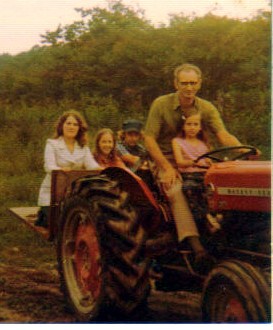
It’s not the back of the truck, but another fond memory on the farm with Dad. On the back: my cousin Debbie, sister Donna, and brother David (JD).

One of my fondest childhood memories is riding in the back of my dad’s truck. I remember being a lookout for a crop of tobacco I had spotted earlier that day, thinking Dad would like to see this field of tobacco. So, when he got in from work, I used my super girl skills to convince him to let me show him. The only problem was I couldn’t find it.

At the time, I was disappointed that something I thought I could connect with my dad was gone. But, looking back, I now have fond memories of riding in his truck, looking for the lustrous tobacco crop I could no longer locate. I now see that Dad took time away from resting after a long day’s work to appease my childhood whimsy.

He saw it as a time to spend with his kids.

My dad got up before dawn every day for 30+ years to drive an hour each way to work at IBM in Lexington. When he got home, he went to the farm to feed, water, and count the cows, besides whatever other chores I did not know about, such as mowing or grading the road with his tractor. And if we happened to be living at the farm (we had spent our summers there since I was nine), he still had to haul water down from our other house every evening because we didn’t have running water at the time. (We thought this was a big adventure – not seeing all the work Dad did to make it happen). I spent many days brushing my teeth with a cup of water and spitting off the side of the porch.

He wasn’t the only one who got up that early; for years, Mom got up with him to prepare a full breakfast before he left for work – at least until they changed their diet to heart-healthy oatmeal. I remember waking up many mornings to the sound of their not-so-quiet whispers in the kitchen. Perhaps the smell of homemade biscuits and gravy, sausage, and eggs awoke my senses to their breakfast chatter; either way, I see how they made time to spend a few minutes alone before we got up.

He did not have to get up that early. He could have grabbed something on the go and spent a few extra minutes in slumber, but he chose to connect with Mom during those early mornings, and she chose to get up with him and make breakfast and sip coffee from saucers in the wee hours of the morning. They found time to spend together in a five-room house full of kids. (Talk about tiny house living – we had no idea it would become popular).

It is those precious memories that aren’t soon forgotten.  I think that is the most important thing God asks of us – to spend time with our heavenly Father. All He wants is to spend time with His kids – and we are better off for taking the intentional time to connect. Sometimes, that may mean getting up a little earlier and being still before the hustle and bustle of our day begins. It is allowing His whispers to seep into our heart and mind awakening us to the sweet aroma of the bread of life that feeds our hungry souls.

Jesus replied, ‘I am the bread of life. Whoever comes to me will never be hungry again. Whoever believes in me will never be thirsty’ ” (John 6:35, NLT, emphasis added).

“Be still and know that I am God” (Ps. 46:10, Emphasis added).