

Paying it Forward: Part Two – Our Testimony Matters

Last week, we looked at the relationship between Jethro and Moses and how a mentor’s wisdom can help us avoid burnout, as Jethro showed Moses how to delegate tasks effectively. This week, we examine how Moses helped lead Jethro to faith in God.

Moses helped lead Jethro, a Midianite priest, to faith through his testimony of the Lord’s work (18:1-12). Jethro had been caring for Moses’ wife, Zipporah, and his two sons while Moses was leading the Israelites out of Egypt. This oral history of the Exodus served as Moses’s powerful testimony (Ex. 18:8).

Jethro’s response was to rejoice, bless the Lord, recognize Yahweh as the God of Israel, and offer burnt offerings as a profound act of worship (Exodus 18:9-12). This event is especially significant because it demonstrates the powerful influence of personal testimony and a non-Israelite’s acknowledgment of the God of Israel.

Not only did Jethro give Moses practical advice on leadership and governance, as we saw in last week’s blog, “Paying it Forward,” but Moses’ testimony also led his father-in-law to faith. Sometimes, accepting wise counsel is difficult, but it requires humility, as demonstrated by Moses, and recognizing our weaknesses to receive a more effective solution.

Similarly, personal testimony can inspire others. This shows how sharing what God has done in our lives can be a powerful way to lead others to faith or deepen their existing relationship with God. Note that before offering practical advice, the shared testimony laid the foundation of their relationship and Jethro’s spiritual growth.

Our relationship with God has a direct impact on our spiritual growth.

This direct connection emphasizes three essential elements that are key to growth, all centered on the relationship.

  1. Communication (Prayer and Scripture): A relationship requires talking and listening.
    1. Prayer is communicating with God—making requests, giving thanks, and confessing. Jesus consistently prioritized prayer, demonstrating that it is directly aligned with the Father’s will and power.
    1. Scripture involves listening to God by learning His character, will, and commands. Spiritual growth needs the ongoing nourishment and guidance found in His Word.
  2. Obedience and Trust: A strong relationship builds trust and encourages action.
    1. Moses obeyed God’s commands to go to Pharaoh, even when fearful.
    1. The disciples followed Jesus’ instruction to “Go and make disciples.”
    1. Our obedience to what God reveals in His Word naturally shows our trust in His goodness and wisdom, serving as the motivating force for spiritual growth.
  3. Presence and Solitude (The “Recharge”) involves setting aside focused, dedicated time for growth.
    1. Jesus often withdrew to be alone with God. This practice of solitude protects the relationship from being overwhelmed by the demands of the world (or, in a work setting, the demands of the job). This dedicated time encourages a deeper intimacy and dependence on God.

By intentionally cultivating this relationship—through communication, obedience, and dedicated time—we invite the grace and guidance necessary for genuine, lasting spiritual growth.

Therefore, do not be ashamed of the testimony about our Lord” (2 Timothy 1:8, ESV, Emphasis added).

Go therefore and make disciples of all nations, baptizing them in the name of the Father and of the Son and of the Holy Spirit, teaching them to observe all that I have commanded you” (Matthew 28:19-20, Emphasis added).

Paying It Forward: Cultivating a Generational Legacy Through Mentorship and Rest

Sometimes we need a fresh perspective from wise counsel. We all can benefit from having a more experienced mentor in our lives, whether it’s for advice on daily matters or for spiritual guidance.

In turn, we can serve as a resource for others who can benefit from our knowledge and experiences. It’s a generational act of paying it forward. We are called to disciple others and to pursue discipleship and accountability within the Christian community.

The idea of discipleship guarantees that faith—and the practical wisdom gained through life—is not lost after just one generation but is repeatedly multiplied and reinforced through intentional relationships.

One notable example of this in the Bible is when Moses’ father-in-law, Jethro, visited him in the wilderness and watched Moses judge disputes among the people (Ex. 18:13-23, NLT). Moses served as a mediator. Only Jesus surpassed Moses as an intercessor between God and humans (Acts 17:26; Heb. 3).

Still, Moses took on the burden of handling all cases himself. Jethro advised him on how to organize the people and delegate the minor disputes to honest men who feared God, so that neither the people nor Moses would become exhausted. Moses listened to Jethro (18:12-24). In today’s world, we would call this experiencing burnout.

It’s always wise to step back and evaluate how much we’ve taken on ourselves when others can assist. We also need mental breaks and time with God to reassess our load, recharge, and be filled so we can better serve others. Running on empty isn’t good for us or those we serve. Sometimes, we have to say no to good things in order to say yes to better ones.

Jethro’s wise advice illustrates God’s leadership approach of providence—delegating authority (NLT Study Bible Notes).

Jesus exemplifies a leader who delegates. As Biblehub.com explains, He didn’t hoard all the work; instead, He trained others and empowered them to join His mission. The Twelve Apostles (Mark 3:14-15; Luke 9:1-6) are an example: Jesus chose twelve disciples, gave them “power and authority over all demons, and to cure diseases,” and sent them out to preach the kingdom of God. This was His initial delegation of ministerial duties. Later, He appointed seventy-two more disciples who went out two by two to all the towns and places He planned to visit. This helped spread the message more widely and quickly.

Jesus consistently emphasized the importance of rest, solitude, and spiritual renewal—concepts often called withdrawal or retreat. He balanced demanding ministry work, like teaching, healing, and feeding crowds, with intentional times away from people’s demands (Mark 1:35; Luke 6:12; Mark 6:30-32; Luke 22:39-44). This biblical pattern highlights the need to avoid burnout, devote time to God, and prioritize rest and renewal.

Please tune in next week for Part Two of “Paying It Forward,” when we will explore the other side of the relationship and how Moses helped Jethro.

Reflections

This past weekend, I was frantically trying to finish writing my paper for class and keeping one eye on the weather so that if a window of opportunity opened, I would be ready to pounce and head to the lake for one last kayaking adventure for the season. As I finished writing the conclusion, I realized that the rain clouds had dissipated, and the sun began to peek through ever so slightly. This was a gift – and I didn’t let it pass me by.

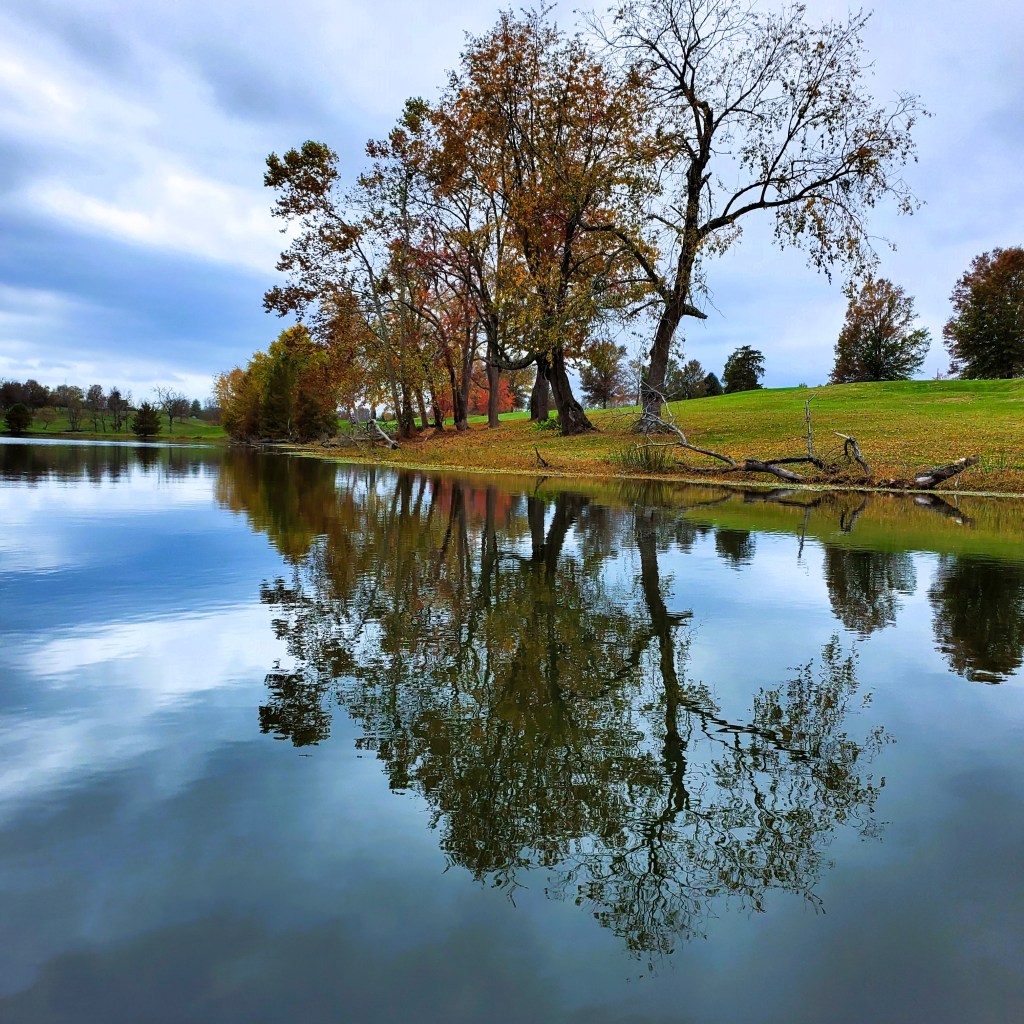
As I launched into the water, it seemed to be calmer than usual, and as you can see from the photo above, as I entered my favorite cove, I was enamored by the Fall colors and how the reflection on the water looked like glass. Over the last few weeks, I have gone to the same lake every weekend, but each time it presented a different experience. One weekend, the water was choppy, allowing the ripples to supply a bit of a workout as I was headed into the wind.

Another time, the sun was shining brightly as I maneuvered through the moss-covered waters to coast upon the cove and was greeted by a magnificent brown spotted egret that adorned the water’s edge. And there were a couple of weeks so chilly I had to wear a jacket. I am delighted to say that for my last hoorah, I did not need a coat this weekend.

I sat there, taking it all in for several solemn moments as the area surrounding the lake was bustling with activity from squirrels and birds– an awe-inspiring moment with the Creator I saw as another gift. Not only did I get to kayak to the middle of all this action and see fantastic views and fall colors, practically having the lake all to myself, but I was able to photograph them as well – another one of my favorite hobbies. (Combining hobbies makes me smile).

Being on the water gave me a different perspective than I had ever experienced when taking photos of Autumn colors. It was a new way to look at the trees. Upon further reflection, these variations at the lake made me think about the changes in our lives. Change, good or bad, can cause a certain level of anxiety at times. But as the Greek philosopher Heraclitus famously said, “Change is the only thing constant in life.”  How we look at change can make a difference.

As Christ-followers, we are called to constant change – through sanctification – to become more Christlike. It is a gradual change over time but a necessary one so that we can conform to the image of Christ (Rom. 8:29). Paul encourages the Romans not to conform to this world but to allow their minds to be renewed through transformation (Rom. 12:2). Striving for spiritual growth is paramount to this. We can begin to welcome these changes in our lives because we can experience a more intimate relationship with God, who, then, we can relate to as our Abba Father.

This kind of relationship can be found through the love our Father has for us and the love we give back to Him and others. Paul also tells the Romans that nothing in all creation will ever be able to separate us from the love of God (Rom. 8:39). Reflect on that for a moment. Isn’t that excellent news for sinners like us?

Next time you get to be in nature – whether on the lake or in the woods – take the opportunity to reflect on the awe-inspiring design of a loving God who redeems, restores, forgives, and accepts us just as we are. As we enjoy His creations as the gifts they are meant to be, we can begin to reflect on the unimaginable Paradise to come. What a day that will be.

“There is therefore now no condemnation for those who are in Christ Jesus” (Rom. 8:1, ESV, Emphasis added).